






Fuel Smell Inside Cabin

Thread Starter
Member
Joined: Jun 2008
Posts: 188
Likes: 1
From: Los Angeles, CA
2007 E550 Sports
Fuel Smell Inside Cabin
Sorry guys, hate to beat a dead horse as this has been covered many times before. All of the issues I saw on the board was for 2003-2004 and E55 or E63s. But I have yet to see any discussion regards about 07-09 E350 or E550s.
My questions are, has the MBUSA issued an recall for this issue? If not, what exactly needs to be replaced and how much will it cost? I can barely stand the smell any more and hate to even fill up my gas.
Any help is greatly appreciated!!
My questions are, has the MBUSA issued an recall for this issue? If not, what exactly needs to be replaced and how much will it cost? I can barely stand the smell any more and hate to even fill up my gas.
Any help is greatly appreciated!!

MBWorld Fanatic!


Joined: Aug 2006
Posts: 7,053
Likes: 398
From: A.D., U.A.E
2000 (W202 C200) & 2000 (W202 C55)

Senior Member
Joined: May 2014
Posts: 485
Likes: 31
From: Concord, CA
'13 E350 . M276
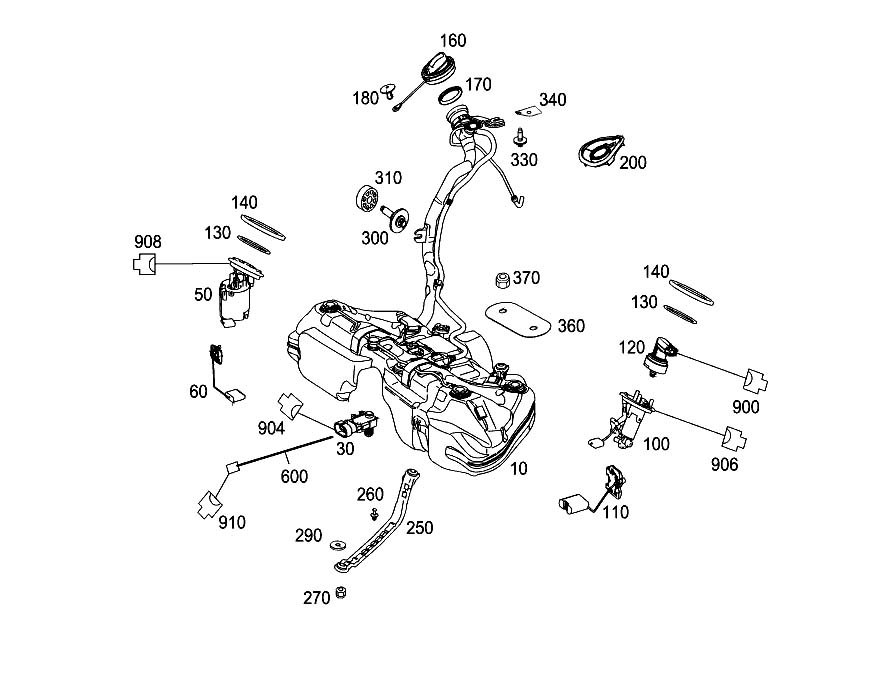
I had this issue in my car, and it was the sending unit (driver's side). Before I changed it, I would fill up tank up to 3/4 only, and this way I avoided having the fuel odor and fumes insides car.
To be on the conservative side, start by removing the rear seat bench and take off the round cover that covers the sending unit. If you see gas on the unit, it could be the unit is leaking and needs to be changed. If gasoline is only on bottom of unit, it could be a bad seal which you could replace yourself if you're a handy person.
To be on the conservative side, start by removing the rear seat bench and take off the round cover that covers the sending unit. If you see gas on the unit, it could be the unit is leaking and needs to be changed. If gasoline is only on bottom of unit, it could be a bad seal which you could replace yourself if you're a handy person.
Last edited by Stuttgarten; Jun 18, 2014 at 11:40 PM. Reason: Add attachments....

Super Moderator


Joined: Jul 2003
Posts: 22,075
Likes: 980
From: MBworld
bone stock E55 AMG
Sorry guys, hate to beat a dead horse as this has been covered many times before. All of the issues I saw on the board was for 2003-2004 and E55 or E63s. But I have yet to see any discussion regards about 07-09 E350 or E550s.
My questions are, has the MBUSA issued an recall for this issue? If not, what exactly needs to be replaced and how much will it cost? I can barely stand the smell any more and hate to even fill up my gas.
Any help is greatly appreciated!!
My questions are, has the MBUSA issued an recall for this issue? If not, what exactly needs to be replaced and how much will it cost? I can barely stand the smell any more and hate to even fill up my gas.
Any help is greatly appreciated!!
replaced fuel sending unit/pump and few other minor stuffs...
is ur car out of warranty?
Thread Starter
Member
Joined: Jun 2008
Posts: 188
Likes: 1
From: Los Angeles, CA
2007 E550 Sports
Thanks guys for all the suggestions, I am going to try to remove the back seat first and see what's going on. (Like I know what I am looking at... lol)
How much did you guys paid to have it replaced? Yeah, my car is way out of warranty. I currently have 115k miles on it.
How much did you guys paid to have it replaced? Yeah, my car is way out of warranty. I currently have 115k miles on it.
Trending Topics
MB World Stories
The Best of Mercedes & AMG

7 Craziest Things AMG Gas Ever Built
Verdad Gallardo
New Electric Mercedes-AMG GT 4-Door Coupe Unveiled: 10 Things You Need to Know
Verdad Gallardo
6 Mercedes Models That Did NOT Age Well (But Are Somehow Still Cool)
Verdad Gallardo
Manual Mercedes? 6 Times Sindelfingen Let Drivers Have All The Fun
Verdad Gallardo
Mercedes SLR McLaren 722 S Is Extremely Rare Example Modified by McLaren
Verdad Gallardo
8 Classic Boxy Mercedes Designs That Have Aged Like Fine Wine
Verdad Gallardo
Flawlessly Restored Mercedes 190E Evo II Heads to Auction
Verdad Gallardo
Electric Mercedes C-Class Unveiled: 11 Things You Need to Know
Verdad Gallardo
Mercedes EQS Gets A Major Update: Everything You Need to Know
Verdad Gallardo
Newbie
Joined: Apr 2014
Posts: 3
Likes: 0
2007 E350
Trying not to give you a heart attack, but, if like mine, you'll end up replacing the whole fuel tank. The dealer first replaced the sending unit seals twice with no change in symptoms.
Frist, remove the bottom of the back seat, there are two tabs under the cushion that will allow you to remove it. You will then need to remove the access pannel that covers the sending unit, behind the driver's seat, which is round and has about 8 or so sheet metal screws in it, they're about 1/4 or 5/16 in size.
If you see gas puddling up on top of the sending unit, mine had about 3 cups worth, get it out of there...I used a shopvac, because there was too much to soak up with rags. Once it is dried up, see if you can tell where it's leaking from. If it's coming up from the bottom, it's more than likely the seals, if it's leading from up and behind (towards the back of the car) into the trough that the sending unit sits in, it's probably a cracked fuel tank.
If MB USA doesn't cover the cost of the fuel tank, like they did in my case, you'll end up spending $3K to fix this.
Frist, remove the bottom of the back seat, there are two tabs under the cushion that will allow you to remove it. You will then need to remove the access pannel that covers the sending unit, behind the driver's seat, which is round and has about 8 or so sheet metal screws in it, they're about 1/4 or 5/16 in size.
If you see gas puddling up on top of the sending unit, mine had about 3 cups worth, get it out of there...I used a shopvac, because there was too much to soak up with rags. Once it is dried up, see if you can tell where it's leaking from. If it's coming up from the bottom, it's more than likely the seals, if it's leading from up and behind (towards the back of the car) into the trough that the sending unit sits in, it's probably a cracked fuel tank.
If MB USA doesn't cover the cost of the fuel tank, like they did in my case, you'll end up spending $3K to fix this.

Out Of Control!!
Joined: Jul 2003
Posts: 15,901
Likes: 4,633
From: North Scottsdale, AZ
'71 Pinto
Note if your vehicle is PZEV in CA warranty coverage runs 15 years/150,000 miles (whichever comes first) - https://mbworld.org/forums/4832241-post5.html
Senior Member
Joined: May 2014
Posts: 485
Likes: 31
From: Concord, CA
'13 E350 . M276
Mine is not a PZEV, so I had to cover all costs, which were not too bad, coz I had repairs done at an INDY. Sending unit with sensor and adaptor cost me $350 from dealer. Seal was $25 online. You probably could get parts cheaper on "Fleabay" I paid an INDY $120 for installation, but I took car in with seat and sound barrier taken out, and area around tank's sending unit covered with shrink wrap. It helped making sure while he worked on car he did not place my seat on his "greasy" garage benches/floors, and that he did not leave smudges on doors or car interiors.
If your car is a PZEV, then dealer has to cover it under warranty.
If your car is a PZEV, then dealer has to cover it under warranty.

Out Of Control!!


Joined: Aug 2010
Posts: 12,517
Likes: 628
From: Charlotte NC area
2019 WS222 S450 4-Matic / 2007 W211 E350 4Matic (Sold) / 2008 X164 GL320 CDI
. . . . . .
Then I saw this:
Since it appears that no one mentioned it is a bad idea to suck fuel into a closed container, while mixing it very well with air, and topping off with a brush type AC motor; Maybe knowing not to do so is a special skill?

Newbie
Joined: Apr 2014
Posts: 3
Likes: 0
2007 E350
I was about to say that it really doesn't take any special skills or knowledge to replace fuel pump related components, and you were being overly cautious.
. . . . . .
Then I saw this:
And thought, maybe I am wrong.
Since it appears that no one mentioned it is a bad idea to suck fuel into a closed container, while mixing it very well with air, and topping off with a brush type AC motor; Maybe knowing not to do so is a special skill?
. . . . . .
Then I saw this:
And thought, maybe I am wrong.
Since it appears that no one mentioned it is a bad idea to suck fuel into a closed container, while mixing it very well with air, and topping off with a brush type AC motor; Maybe knowing not to do so is a special skill?
There is so much wrong with your comments about shopvac'ing up gas I don't even know where to begin. Maybe it's just best to ignore your comments for those who read that. Guess what? I still have all of my fingers, I'm not missing any eyebrows and my shopvac didn't blow up like a pressure cooker bomb
 . HOW COULD THAT BE? I must have defied physics and chemistry in the alternate universe you live in. Before you give advice on a subject you might want to know something about it...just a suggestion.
Anyways, the point of the subject, if you can determine where the leak is, roughly, coming from you can figure out if it's a cracked gas tank or if it is simply a fuel sending unit seal.
Out Of Control!!
Joined: Aug 2010
Posts: 12,517
Likes: 628
From: Charlotte NC area
2019 WS222 S450 4-Matic / 2007 W211 E350 4Matic (Sold) / 2008 X164 GL320 CDI
http://ehs.research.uiowa.edu/spill-...stible-liquids
http://www.ford-trucks.com/forums/48...e-liquids.html
http://www.ford-trucks.com/forums/48...e-liquids.html
When using an electrical appliance, basic precautions should always be followed, including the following: READ ALL INSTRUCTIONS BEFORE USING THIS APPLIANCE.
WARNING – TO REDUCE THE RISK OF FIRE, ELECTRIC
SHOCK OR INJURY:
1. Do not leave appliance when plugged in. Unplug from outlet when not in use and before servicing. Connect to a properly grounded outlet only. See Grounding Instructions.
2. Do not expose to rain – store indoors.
3. Do not allow to be used as a toy. Close attention is necessary when used by or near children.
4. Use only as described in this manual. Use only Manufacturer’s recommended attachments.
5. Do not use with damaged cord or plug. If appliance is not working as it should, has been dropped, damaged, left outdoors or dropped into water, contact Shop-Vac Corporation for assistance.
6. Do Not: pull or carry by cord, use cord as a handle, close a door on cord or pull cord around sharp edges or corners. Do not run appliance over cord. Keep cord away from heated surfaces.
7. Do not unplug by pulling on cord. To unplug, grasp the plug; not the cord.
8. Do not handle plug or appliance with wet hands.
9. Do not put any object into openings. Do not use with any openings blocked; keep free of dust, lint, hair and anything that may reduce air flow.
10. Keep hair, loose clothing, fingers and all parts of body away from openings and moving parts.
11. Do not pick up anything that is burning or smoking, such as cigarettes, matches or hot ashes.
12. Do not use without dust bag and/or filters in place.
13. Turn off all controls before unplugging.
14. Use extra care when cleaning on stairs.
15. Do not use to pick up flammable or combustible liquids such as gasoline or use in areas where they may be present.
16. Do not use your cleaner as a sprayer of flammable liquids such as oil base paints, lacquers, household cleaners, etc.
17. Do not vacuum toxic, carcinogenic, combustible or other hazardous materials such as asbestos, arsenic, barium, beryllium, lead, pesticides or other health endangering materials.
Specially designed units are available for these purposes.
18. Do not pick up soot, cement, plaster or drywall dust without cartridge filter and collection filter bag in place. These are very fine particles that may pass through the foam and affect the performance of the motor or be exhausted back into the air. Additional collection filter bags
are available.
19. Do not leave the cord lying on the floor once you have finished the cleaning job. It can become a tripping hazard.
20. Use special care when emptying heavily loaded tanks.
21. To avoid spontaneous combustion, empty tank after each use.
22. The operation of a utility vac can result in foreign objects being blown into eyes, which can result in eye damage. Alwayss wear safety goggles when operating vacuum.
23. STAY ALERT. Watch what you are doing and use common sense. Do not use vacuum cleaner when you are tired, distracted or under the influence of drugs, alcohol or medication causing diminished control.
24. WARNING! Do NOT use this vacuum cleaner to vacuum lead paint debris because this may disperse fine lead particles into the air. This vacuum cleaner is not intended for use under EPA Regulation 40 CFR Part 745 for lead paint material cleanup.
WARNING – TO REDUCE THE RISK OF FIRE, ELECTRIC
SHOCK OR INJURY:
1. Do not leave appliance when plugged in. Unplug from outlet when not in use and before servicing. Connect to a properly grounded outlet only. See Grounding Instructions.
2. Do not expose to rain – store indoors.
3. Do not allow to be used as a toy. Close attention is necessary when used by or near children.
4. Use only as described in this manual. Use only Manufacturer’s recommended attachments.
5. Do not use with damaged cord or plug. If appliance is not working as it should, has been dropped, damaged, left outdoors or dropped into water, contact Shop-Vac Corporation for assistance.
6. Do Not: pull or carry by cord, use cord as a handle, close a door on cord or pull cord around sharp edges or corners. Do not run appliance over cord. Keep cord away from heated surfaces.
7. Do not unplug by pulling on cord. To unplug, grasp the plug; not the cord.
8. Do not handle plug or appliance with wet hands.
9. Do not put any object into openings. Do not use with any openings blocked; keep free of dust, lint, hair and anything that may reduce air flow.
10. Keep hair, loose clothing, fingers and all parts of body away from openings and moving parts.
11. Do not pick up anything that is burning or smoking, such as cigarettes, matches or hot ashes.
12. Do not use without dust bag and/or filters in place.
13. Turn off all controls before unplugging.
14. Use extra care when cleaning on stairs.
15. Do not use to pick up flammable or combustible liquids such as gasoline or use in areas where they may be present.
16. Do not use your cleaner as a sprayer of flammable liquids such as oil base paints, lacquers, household cleaners, etc.
17. Do not vacuum toxic, carcinogenic, combustible or other hazardous materials such as asbestos, arsenic, barium, beryllium, lead, pesticides or other health endangering materials.
Specially designed units are available for these purposes.
18. Do not pick up soot, cement, plaster or drywall dust without cartridge filter and collection filter bag in place. These are very fine particles that may pass through the foam and affect the performance of the motor or be exhausted back into the air. Additional collection filter bags
are available.
19. Do not leave the cord lying on the floor once you have finished the cleaning job. It can become a tripping hazard.
20. Use special care when emptying heavily loaded tanks.
21. To avoid spontaneous combustion, empty tank after each use.
22. The operation of a utility vac can result in foreign objects being blown into eyes, which can result in eye damage. Alwayss wear safety goggles when operating vacuum.
23. STAY ALERT. Watch what you are doing and use common sense. Do not use vacuum cleaner when you are tired, distracted or under the influence of drugs, alcohol or medication causing diminished control.
24. WARNING! Do NOT use this vacuum cleaner to vacuum lead paint debris because this may disperse fine lead particles into the air. This vacuum cleaner is not intended for use under EPA Regulation 40 CFR Part 745 for lead paint material cleanup.

Member
Joined: Jun 2011
Posts: 144
Likes: 2
From: Orange County, Ca
2007 E350 RWD SP1 (M211.056/E272.964)
Mine is not a PZEV, so I had to cover all costs, which were not too bad, coz I had repairs done at an INDY. Sending unit with sensor and adaptor cost me $350 from dealer. Seal was $25 online. You probably could get parts cheaper on "Fleabay" I paid an INDY $120 for installation, but I took car in with seat and sound barrier taken out, and area around tank's sending unit covered with shrink wrap. It helped making sure while he worked on car he did not place my seat on his "greasy" garage benches/floors, and that he did not leave smudges on doors or car interiors.
If your car is a PZEV, then dealer has to cover it under warranty.
If your car is a PZEV, then dealer has to cover it under warranty.



Newbie
Joined: Nov 2023
Posts: 1
Likes: 0
2014 E350
Thanks !!
I had this issue in my car, and it was the sending unit (driver's side). Before I changed it, I would fill up tank up to 3/4 only, and this way I avoided having the fuel odor and fumes insides car.
To be on the conservative side, start by removing the rear seat bench and take off the round cover that covers the sending unit. If you see gas on the unit, it could be the unit is leaking and needs to be changed. If gasoline is only on bottom of unit, it could be a bad seal which you could replace yourself if you're a handy person.
To be on the conservative side, start by removing the rear seat bench and take off the round cover that covers the sending unit. If you see gas on the unit, it could be the unit is leaking and needs to be changed. If gasoline is only on bottom of unit, it could be a bad seal which you could replace yourself if you're a handy person.
Thanks for sharing !!
Senior Member
Joined: May 2014
Posts: 485
Likes: 31
From: Concord, CA
'13 E350 . M276
Last edited by Stuttgarten; Nov 2, 2023 at 10:43 AM.
Out Of Control!!
Joined: Aug 2010
Posts: 12,517
Likes: 628
From: Charlotte NC area
2019 WS222 S450 4-Matic / 2007 W211 E350 4Matic (Sold) / 2008 X164 GL320 CDI


