When you click on links to various merchants on this site and make a purchase, this can result in this site earning a commission. Affiliate programs and affiliations include, but are not limited to, the eBay Partner Network.
Just wanna share.
Last week I was testing my brakes , sometime I do this drill when I have not used the car 2 weeks or so.
I will run fast and brake hard to shed off at least 60-70 KM/H of velocity till ABS kicks in.
This time I am getting brake pulsation way before it should happen, I am not getting enough stopping G force to warrant a pulsation.
In fact the W212 ABS to me I find very smooth compared to my Ford Fiesta, pulsation wise when triggered.
So , naturally I have to measure axial run out of the front rotor and wheel bearing freeplay.
Wheel bearing play was inspected and adjusted not so long ago, Oct 2020 and was 4,000KM ago or so. Still I did the wiggle test, all good.
I then measure the rotor run-out and got nice numbers, considering the rotor only have 0.8mm more of use-able life of 40% or approx 19,000KM more kilometers as of 29,000KM odometer.
I am getting good numbers as below. Apology for the silly remarks I reminded myself
For imperial : 0.025mm is 1/1,000 inch , to be exact 0.0254mm is 1/1,000 of an inch.
So rotor is okey.
Anyway, I need to also check the hub to rotor interface for rust effecting the actual run-out I am reading.
And yes, the rust at hub to rotor interface itself has 0.02mm value at its worst side ... LOL. I can see my Dial Gauge jumping up 0.02mm when it hit the rust.
The rotor itself has less stubborn rust interface
The Left Front side rotor run-out value is near the same with the Right side one, also rust caused.
My car has the option 950 AMG-wannabe sports brake for front one , 344mm rotor. So it is a 4 pistons and not a floating caliper, it is a fixed caliper.
This means I can not suspect the typical slider tube/rod of floating single piston type caliper which may get stuck or movement hampered due to dirt/rust and cause pulsation.
I very recently serviced the rear brake + handbrake, all good. Rear is a single piston and a floating caliper with handbrake pads internally in the rotor cavity.
So the front brake pad needs to be inspected and hopefully a peek at the 4 pistons from outside view. I don't even know how/where to get the seal and boot repair kit for my Brembo/AMG 4 pistons caliper,
so I don't want to touch the caliper...yet. EPC as far as I recalled does not show seal kit for calipers. I will check again later.
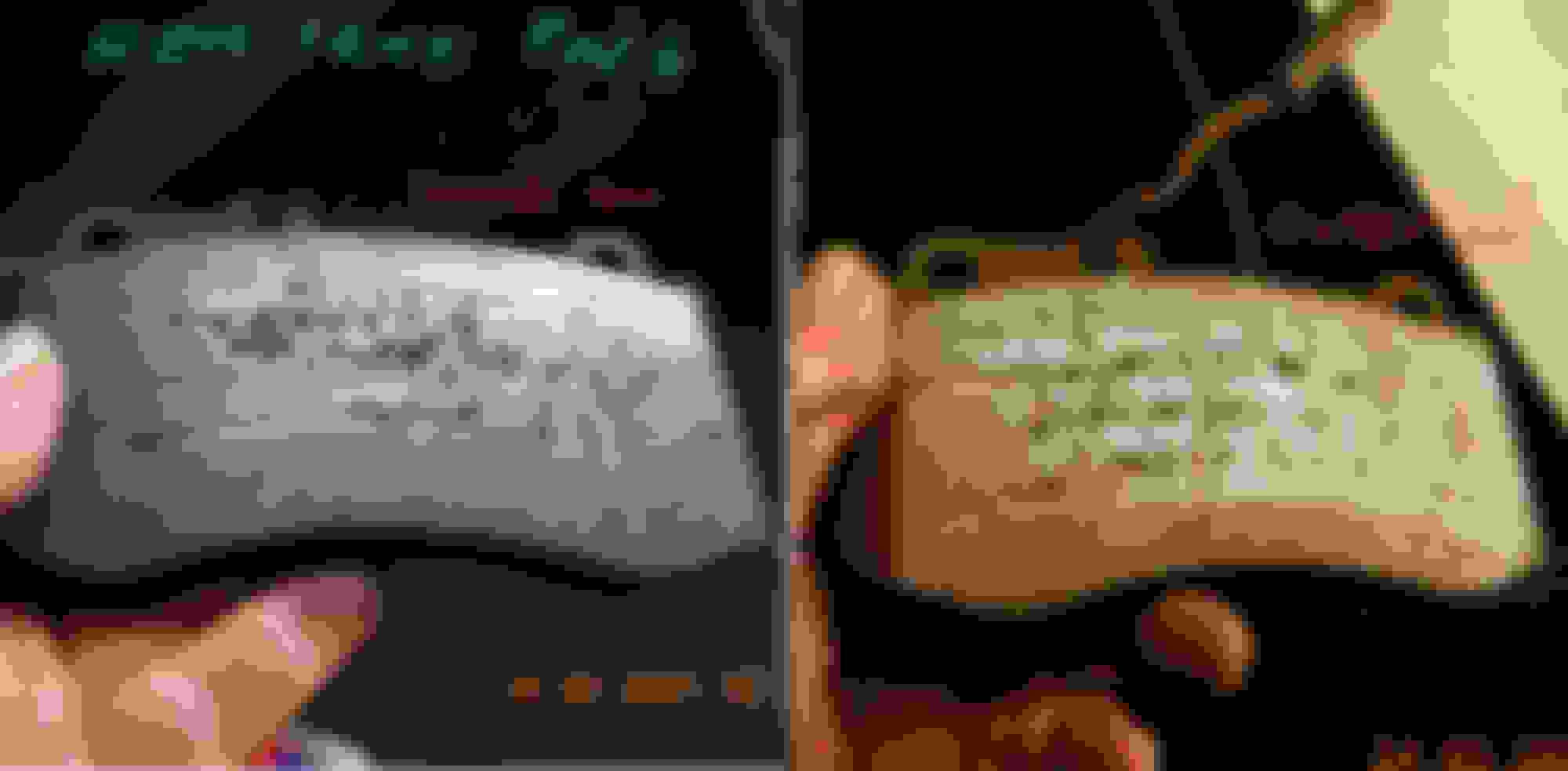
Hold and behold, thanks to a camera view and I can zoomed in properly ( unlike my tired eyes) , I am seeing heat damage.
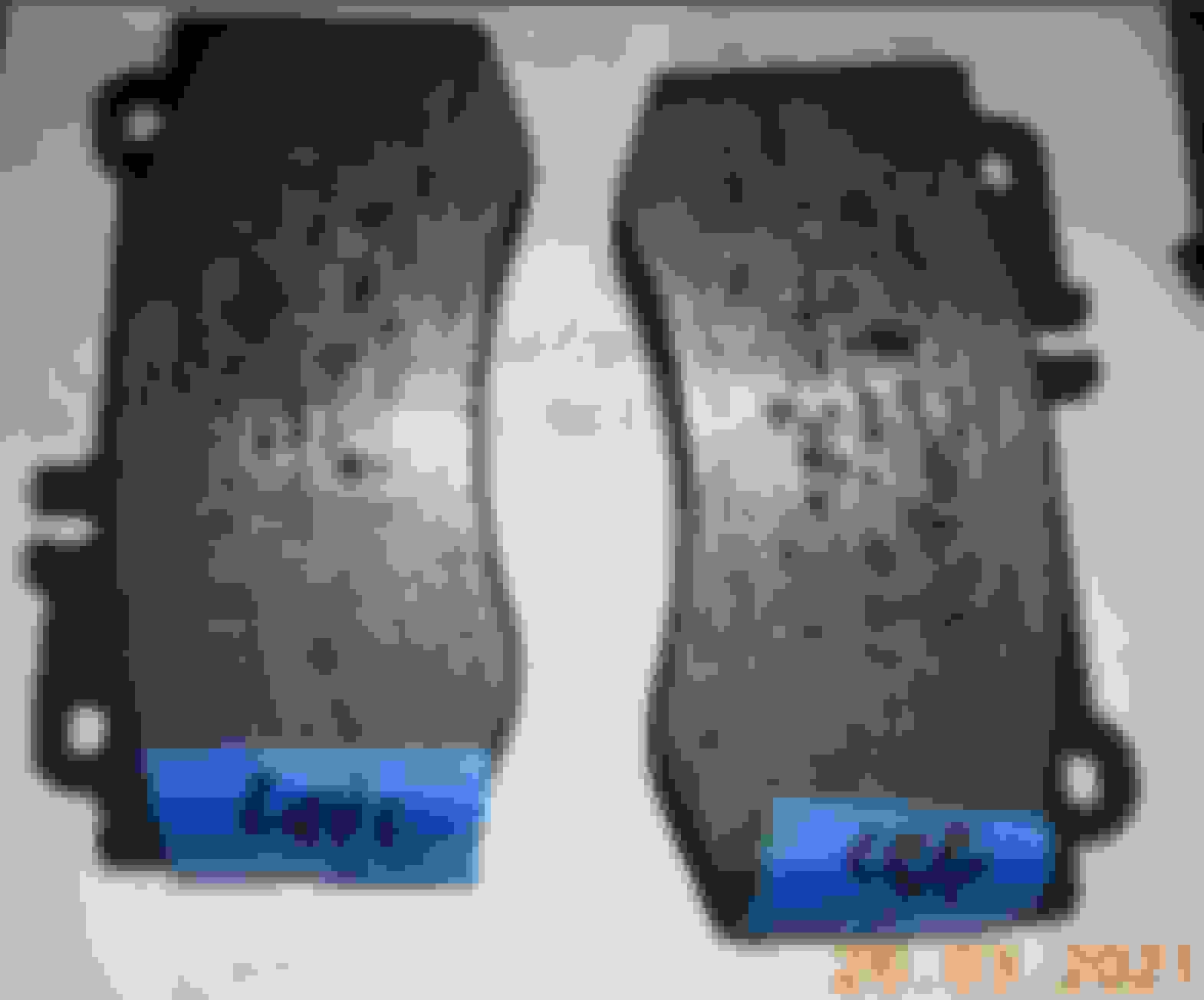
So I looked for my 1st set, the old-original complete set of front and rear brake pads, which I knew has still a good 10,000 - 15,000 KM more of use and at the same time I am now able to do a end of life calculation for brake pads and front rotor. I have enough data now.
Below also shows how a normal front brake pad would look like after 20,100KM of use.
So to finish up, I applied super thin layer of anti-seize at hub only and not the rotor, for ease of removal next time.
No wheel lug thread get the anti-seize...
The pins where brake pad will slide, and that "spring/tensioner" get anti seize too. These areas extra thin layer..
Removal of rotors was using tracker. I don't like hammering a rotor free, I love my bearing at the hub
Not to forget safety.
Quick Jack alone does not give me a piece of mind from potential failure.
So 3 of my trusted DIY wheel stands are on stand-by to catch a Quick Jack failure.
Only front , and one side, the DIY wheel stand I raised just enough to provide friction to tire when I do the opposite side rotor run-out test. Its like a cheap steering lock device so to speak.
The front jack #2 green below and also #1 at the rear differential are also for extra safety, since I can't use my 4th DIY wheel jack to support the right side wheel I am working on.
At the same time , the jacks are also to take some load off the Quick Jack 4 supports points ( 4 of Benz designated jack points ). I don't want my chassis to bend upward in the middle...LOL
Front engine subframe is a very good well spread out load carrier for a jacking point.
The child in me doing the brake test ...............
I think by another few hundred KM's, the old 1st set of front pads will re-acquaintance itself with the ugly wear pattern on the rotor from the drilled holes.
They been divorced for 9,100 KM .... LOL
Mercedes SLR McLaren 722 S Is Extremely Rare Example Modified by McLaren
Slideshow: A one-of-one U.S.-spec Mercedes-Benz SLR McLaren Roadster became even rarer after a factory-backed transformation at McLaren's headquarters.









 ) , I am seeing heat damage.