When you click on links to various merchants on this site and make a purchase, this can result in this site earning a commission. Affiliate programs and affiliations include, but are not limited to, the eBay Partner Network.
Recently my e350 started to “overheat” verified by the dashboard temperature gauge, however whenever I turn the heat on it instantaneously drops down to operating temperature (80-85°C). I’ve been to a mechanic twice, the first time was due to service AH being required and I got my water pump and belt replaced and coolant flushed. The second time I went to a Meineke for diagnostics and they deemed the issue was a faulty coolant temperature sensor and replaced said sensor and ruled out the thermostat due to it be being replaced 4 months prior. Not a day later I had the same issue, I brought it back to them and they’re now telling me I need to replace my radiator, reservoir, return hose, the whole 9. What might be the actual source of the problem? My vehicle has 160,000 miles on it and it is kept in good condition, mechanically.
What temperature did you read when you deemed as "overheated" ?
The coolant gauge on the instrument cluster is a white liar and will show 90C most of the time while coolant can be 100 to 110C, but will jump to 120C when a true 120C coolant temp happen.
120C and up is honest value.
Read here : https://mbworld.org/forums/w212-amg/...-liar-too.html
White lie in progress of coolant analog gauge. The digital gauge is OBD2 data and it is honest data.
.
------------------------
Is your engine M272 or M276 ?
Walter wrote in blue italic : Recently my e350 started to “overheat” verified by the dashboard temperature gauge, however whenever I turn the heat on it instantaneously drops down to operating temperature (80-85°C).
The HVAC heater core is like a radiator, so when you use the heater or take away heat from the heater, the engine coolant is then cooler due to that thermal release into your cabin.
I’ve been to a mechanic twice, the first time was due to service AH being required and I got my water pump and belt replaced and coolant flushed.
At times when air bubble is still stuck or plenty within the cooling system, intermittent overheat can happen as too much air can cause coolant pump cavitation.
Using vacuum system to refill coolant is the the best. Below is actually vacuum operation but using compressed air as power source, venturi effect.
Like below :
The second time I went to a Meineke for diagnostics and they deemed the issue was a faulty coolant temperature sensor and replaced said sensor and ruled out the thermostat due to it be being replaced 4 months prior.
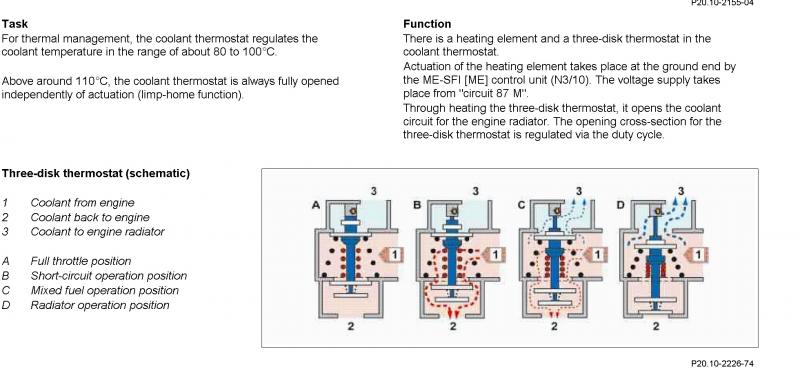
If your engine is M272 and if it is similar to M276 thermal management, the thermostat is a heater assist type of thermostat.
The mechanical opening of the thermostat ( wax melting ) is at about 95C and at about 105C it then fully open.
The heater is there to assist in opening up the thermostat sooner than 95C, and is engine computer controlled.
TEST 1
One can read the voltage or as duty cycle, sent to the heater, to confirm if indeed the ECM sent out power ( using PWM ) to heater or not, at 95C.
To read true coolant temp of 95C means you need at least OBD2 device or a scanner.
TEST 2
Simple touch test, using your hand. The hose from the thermostat to radiator is the INPUT hose to radiator.
It will only get hot when coolant temp at 95C as thermostat opens up and allow hot coolant to flow to radiator input.
Do this test.
TEST 3
Again the same touch test , but this time at the radiator OUTPUT hose, which leads to the coolant mechanical pump at the engine.
When 95C hot coolant enter the radiator, it will exit slightly cooler, depending on car velocity and/or electric radiator fan speed controlled by ECM.
Run HVAC at full blast, it will force the single electric radiator fan to run a bit faster than usual.
If you see the engine in front of you, the RIGHT side coolant hose of radiator is the INPUT, the left side is the OUTPUT.
Test 3 while it tells you coolant is flowing across the radiator, it does not tell you if there is minor blockage slowing down flow.
One thing for sure, if you radiator has very high blockage inside its small micro channels flat pipes, your engine will melt down for sure.
How dirty is your radiator ? Make sure it is clean externally.
We can not see how clean our radiator fins surface, the wind facing side is, because the HVAC CONDENSER ( heat exchanger ) is always the first layer and that is all you can see.
While this possibility is remote, it can happen :
AA. Wrong coolant type used and/or mixing of two different coolant type, one being the wrong one and gel formed inside the radiator. https://www.valvolineglobal.com/en-e...0you%20realise.
BB. I believe you bought the car used....correct ? If so, when and if previous owners been a poor maintainer and uses very hard water or bad quality water instead of distilled water
for the 50/50 mix, you may have internal clogging inside those super small micro channels.
--------------
How decent an DIY-er are you with car engines mechanical wise and know-how wise ?
Do you have a decent scanner ?
Update us yah..... good luck
Last edited by S-Prihadi; Sep 14, 2024 at 05:34 AM.
If your car has sat idle for an extended period of time, check for a blockage between the A/C condenser and the radiator.
I suffered a similar issue in an older EClass, and the cause was a rodent nest between the condenser and radiator, which prohibited airflow through the radiator.
Mercedes SLR McLaren 722 S Is Extremely Rare Example Modified by McLaren
Slideshow: A one-of-one U.S.-spec Mercedes-Benz SLR McLaren Roadster became even rarer after a factory-backed transformation at McLaren's headquarters.