



TVT250?? 250HP for 1K, who's heard?

Thread Starter
Banned
Joined: Jun 2007
Posts: 117
Likes: 1
TVT250?? 250HP for 1K, who's heard?
I've bought some parts through them in the past, but I just recently came upoon this thread: http://www.crossfireforum.org/forum/...ad.php?t=23510
Anyone have any thoughts? With the stock airbox this will work any pretty much any 3.2L car. Sounds pretty reasonable for 250HP. Next closest thing would involve new cams.
Anyone have any thoughts? With the stock airbox this will work any pretty much any 3.2L car. Sounds pretty reasonable for 250HP. Next closest thing would involve new cams.
Moderator Alumni
Joined: Apr 2006
Posts: 3,255
Likes: 22
From: Seattle
w203 m112
Interesting... CAI + injectors + tune for 35 hp.... Hmm, their stock tune is really cheap...
Increase: +35 Hp, +22 ft/lbs TQ
Price: $1,000.00
HP/$: 29
Their tune is supposed to only be 350 bux :x
No dynos yet :x
Increase: +35 Hp, +22 ft/lbs TQ
Price: $1,000.00
HP/$: 29
Their tune is supposed to only be 350 bux :x
No dynos yet :x

Super Member
Joined: Jun 2007
Posts: 502
Likes: 0
From: SOCAL
03 c240

Thread Starter
Banned
Joined: Jun 2007
Posts: 117
Likes: 1
Moderator Alumni
Joined: Apr 2006
Posts: 3,255
Likes: 22
From: Seattle
w203 m112
lol. no exhaust provides power in any w203... Its been discussed at length.
Super Member
Joined: Jun 2007
Posts: 502
Likes: 0
From: SOCAL
03 c240
Trending Topics
MBworld Guru


Joined: Apr 2002
Posts: 22,058
Likes: 18
From: Diamond Bar, CA
W206 PHEV AMG
MB World Stories
The Best of Mercedes & AMG

Manual Mercedes? 6 Times Sindelfingen Let Drivers Have All The Fun
Verdad Gallardo
Mercedes SLR McLaren 722 S Is Extremely Rare Example Modified by McLaren
Verdad Gallardo
8 Classic Boxy Mercedes Designs That Have Aged Like Fine Wine
Verdad Gallardo
Flawlessly Restored Mercedes 190E Evo II Heads to Auction
Verdad Gallardo
Electric Mercedes C-Class Unveiled: 11 Things You Need to Know
Verdad Gallardo
Mercedes EQS Gets A Major Update: Everything You Need to Know
Verdad Gallardo
5 Underrated Mercedes-Benz Models That Don't Get the Love They Deserve
Verdad Gallardo
Mercedes 300D Has Pushed Well Past 1 Million Miles and It Ain't Stopping
Verdad Gallardo
10 Most Reliable Mercedes-Benz Models You Can Buy Used
Verdad Gallardo


Super Moderator
Joined: Jul 2006
Posts: 3,365
Likes: 12
From: Orange County, CA
GMC - Miata - Trek - P-Car
...I just recently came upoon this thread: http://www.crossfireforum.org/forum/...ad.php?t=23510...
An otherwise stock M112 (in the MB) does not run excessively lean at full throttle; hence negating the supposed increases from the larger fuel injectors. Our DME maps are tuned closer to ideal spark timing and mixture strength parameters as delivered, thereby leaving less potential gains to be exploited. With respect to TVT Designs, they are marketing to the Chrysler camp, so their claims may indeed be well founded. I applaud their efforts to serve a fickle niche marketplace.
Raising the rev limit of any engine without fitting corresponding hardware is treading on dangerous turf. I’ve broken engines before – it’ll take the wind right out of your sails. AMG installed stiffer valve springs and revised cam profiles to enable raising the redline a mere 200 additional RPM.
The notion that eliminating EGR improves performance at part throttle in a street driven car is spurious. It actually reduces peak combustion temperatures and the formation of oxides of nitrogen, allowing more spark advance for improved throttle response and reduced fuel consumption. It’s an emissions reducing device that actually allows increased efficiency. Go figure. Since EGR is already inoperative at WOT, there are no gains to be had to be had there, either. It is also illegal to tamper with it.
I’m at least as diligent as a few of you in the quest for improved performance. Is $1000 a good deal for 22 lb. ft. of torque and 35 horsepower? Of course! I’ve invested far more for less incremental gains on many of my cars, without regret. Particularly the MBs.
Trust, but verify. It will help to make the modification journey that much more rewarding.
Thread Starter
Banned
Joined: Jun 2007
Posts: 117
Likes: 1
I'll give my limited knowledge on the above quote.
First, just by looking at the EGR system you can see by disabling you will notice an improvement. It vents hot exhaust gases into a long bent tube directly into the top part of the manifold. If nothing else you will reduce intake air temps and spark retarding.
As for the injectors they are used on MODIFIED engines, not stock ones. The Crossfire comes with smaller injectors then the MB motors. At 3bar the Crossfire's are rated at 15.1 lbs/hr and the MB ones are closer to 16.8 lbs/hr. When you start modifying the ECU and amount of air ingested into the engine you start needing more fuel. More air+more fuel= more power. If you have one without the other it will abviously not produce any gains. I think that is why they offer it as a stage and not just the injectors alone touting HP increases.
As for the Rev limiter being raised. I think every flash tune for the M112 N/A motor does this. I know the three or four I have looked at do. I don't see that as a detrimental factor. Mercedes would build very poor engines if there was no tolerance for over revving a small amount. 500-1000 RPM yes, then you're talking about 8-15% increase, but 200 RPM is about a 3% increase.
I've done my research on the topic and they have proven results before with the CAI they released. We'll just have to wait and see what the Dyno proves.
First, just by looking at the EGR system you can see by disabling you will notice an improvement. It vents hot exhaust gases into a long bent tube directly into the top part of the manifold. If nothing else you will reduce intake air temps and spark retarding.
As for the injectors they are used on MODIFIED engines, not stock ones. The Crossfire comes with smaller injectors then the MB motors. At 3bar the Crossfire's are rated at 15.1 lbs/hr and the MB ones are closer to 16.8 lbs/hr. When you start modifying the ECU and amount of air ingested into the engine you start needing more fuel. More air+more fuel= more power. If you have one without the other it will abviously not produce any gains. I think that is why they offer it as a stage and not just the injectors alone touting HP increases.
As for the Rev limiter being raised. I think every flash tune for the M112 N/A motor does this. I know the three or four I have looked at do. I don't see that as a detrimental factor. Mercedes would build very poor engines if there was no tolerance for over revving a small amount. 500-1000 RPM yes, then you're talking about 8-15% increase, but 200 RPM is about a 3% increase.
I've done my research on the topic and they have proven results before with the CAI they released. We'll just have to wait and see what the Dyno proves.
MBWorld Fanatic!
Joined: Jun 2006
Posts: 2,140
Likes: 1
From: Long Island, NY
C3Twon AWD Jumpofffff
what about 12hp for a lot less i'm thinking about selling my evosport underdrive pulley kit brand new, never touched or installed i will post in classified soon. 3 pulleys and a cable

MBWorld Fanatic!
Joined: Jan 2005
Posts: 2,848
Likes: 15
From: Orange County
2005 C Wagon (No snickering please!)
I have to agree with Splinter concerning blocking the EGR and increased RPM in a street car. An additional reason to keep RPM's limited to where the factory set them beyond that mentioned by Splinter is resonance. This is where one part of the engine oscillates and causes another part to oscillate with increased amplitude. This can shake your nuts loose, and I am not talking hex nuts here. I might take a WAG (wild a** guess) at why AMG put heavier valve springs on their version, it is to damp valve resonance.
There is one cost effective way to have more power in a S203 like mine. It is called a C55.

Moderator Alumni
Joined: Apr 2006
Posts: 3,255
Likes: 22
From: Seattle
w203 m112
I just registered on the crossfireforums to keep an eye for what kinda stuff they have been working on. They seem pretty intense about creating intakes.
Splinter, you've outlines some differences between the m112 in the w203 and the crossfires, are there any other differences?
Thread Starter
Banned
Joined: Jun 2007
Posts: 117
Likes: 1
Just an update: http://www.crossfireforum.org/forum/...ad.php?t=23805
Super Moderator
Joined: Jul 2006
Posts: 3,365
Likes: 12
From: Orange County, CA
GMC - Miata - Trek - P-Car
Just an update: http://www.crossfireforum.org/forum/...ad.php?t=23805
Originally Posted by TVT_DESIGN
Brief Explanation
Dynojet
The Dynojet chassis dyno is referred to as an inertia-type dynamometer, because large drums provide an inertial load to the drivetrain instead of a friction brake. The working end of the Dynojet includes two 48-inch diameter drums that are mostly below the surface and driven by the vehicle's drive wheels. In the photos of the Dynojet, notice how the rear wheels are centered on the drums and there is one drum per wheel. This will become important later.
The vehicle is typically run in the transmission gear closest to 1:1 (Forth gear for manuals and Third gear for automatics) to or a variable load that maintains a preset engine rpm or vehicle speed. This feature is ideal for forcing the vehicle to operate at certain loads for tuning. The Dynojet can also measure air/fuel ratio while testing.
Mustang
The Mustang chassis dyno uses an Inertia load as well as an eddycurrent brake load to simulate the "actual" load (combined aerodynamic plus rolling frictional load) that the vehicle would experience when in motion. Notice in the photos how the rear wheels sit between two smaller 10.7-inch diameter rollers. There has been some discussion about the tires getting "pinched" between the rollers and creating more rolling friction, but no substantial evidence of this could be found. However, Mustang has a dyno (MD-1750) with a single 50-inch diameter roller per wheel that alleviates the wheel-pinch concerns. The internals of the Mustang dyno are composed of an eddy current brake to provide a variable load and an inertial disc to provide a fixed load. Mustang claims because its dyno loads the vehicle as it would be on the road, you can perform 0-60 mph, 0-100 mph, and quarter-mile measurements on its chassis dyno. Speed Nation has obtained quarter mile times within 0.1 second of actual runs at the track. We're not sure how the launch dynamics are simulated on the Mustang dyno, which
includes weight transfer, acceleration, jerk (the derivative of acceleration - how fast the acceleration occurs) and some other variables. The Mustang dyno can also measure the air/fuel ratio while testing.
CorrectIon Factors
Correction factors are used by both dynos to account for varying atmospheric conditions such as temperature, pressure, and humidity. The measured horsepower and torque are multiplied by the correction factor to obtain the corrected values. This is similar to the corrected times and speeds provided by some quarter mile tracks. Theoretically, you can dyno on a hot day in the high altitude of Denver and on some other cool day at sea level and produce the same corrected horsepower even though the observed horsepower you are producing at each location is different. Both dynos calculate a correction factor based on a Society of Automotive Engineering document (SAE-J1349). When testing was performed on the Dynojet, the correction factor was 1.10, which means the observed numbers were multiplied by 1.10 (adding 10 percent) to get the corrected values. The correction factor for the day when testing was performed on the Mustang dyno was 0.9595 (removing 4.05 percent). The correction factor when road-testing at
Keystone Raceway was 0.962, a correction reduction of 3.8 percent.
Testing
Testing was performed on each dyno using a '00 six-speed Z28 Camaro. We measured the horsepower and torque versus engine rpm in Second, Third, and Fourth gear. The test data also included how fast the engine accelerated in Second and Third gear (in rpm versus time) to be compared with actual road tests to assess each dyno's loading of the drivetrain. After each individual test we let the engine coolant temperature as displayed by our AutoTap OBD-II scanner to read between 200 and 205 degrees F for consistency. Dynojet sent out a representative to Strope's Speed Shop to verify calibration and witness testing. Calibration for the Dynojet is just a matter of verifying that the computer's configure file has the proper load-roller inertia factor. There are no manual calibrations for the Dynojet.
The road tests were pertorrned at Keystone Raceway to provide a level surface to measure the vehicle's rpm versus time in Second and Third gear using AutoTap. Chad Fellabaum of C&C Racing in Pennsylvania weighed the car so the exact weight could be used for the Mustang dyno loading to be compared with the road tests.
The dyno curve charts show horsepower and torque versus rpm in Third gears for both chassis dynos. You can also see that the Dynojet dyno measures a higher rear-wheel horsepower than the Mustang dyno.
The Dynojet measured 5.1 percent higher horsepower in Fourth gear, 7 percent higher horsepower in Third gear, and 8.2 percent higher horsepower in Second gear. We will try and explain this difference a little later.
Graphs 8 and 9 show the engine rpm versus time when the vehicle was loaded by the Dynojet dyno, Mustang dyno, and the actual road loading at Keystone Raceway in Third gear. You can see that the Mustang dyno loaded the car much closer to the actual loading in Second and Third gears.
Why Is loading the Vehicle Important?
The answer to this Question is twofold. First, the engine produces horsepower at the flywheel (brake horsepower) that is reported by the automobile manufacturers. Engine power is coupled to the rear wheels by a transmission and a rearend. But this is no free ride - there are losses in both the trans and the rearend. Therefore, the power to the rear wheels is equal to the flywheel horsepower minus the drivetrain power loss. The drivetrain losses are
mainly composed of three loss areas: friction loss, inertia loss, and viscous loss. The friction loss is largely due to the surfaces of the gear teeth rubbing against each other. Gear friction is related to the torque being transmitted through the drivetrain. The gear power loss is related to the speed at which the torque is being transmitted. This is why it is recommended to have a transmission cooler for towing. The transmission must couple more torque to pull the boat resulting in more frictional power loss, which shows up as more heat in the transmission to be taken away by the transmission cooler.
Inertial loss is related to the rotational acceleration (i.e., angular acceleration) of the drivetrain components. The inertial loss does not result in a power loss (i.e., heat) but absorbs energy that can be coupled to the rear wheels. This energy actually gets stored in the drivetrain components. The stored inertial energy in the flywheel keeps the revs up while the clutch is pressed in during shifts. The inertia loss is more pronounced in lower gears (i.e., First or Second) when the acceleration is highest. The viscous loss is basically the pumping of lubrication fluid in the transmission and the rearend. This is one reason why you get better e.t's when the
drivetrain is warm, because the oil is thinner and provides less "pumping loss." Therefore, to measure the actual rear-wheel horsepower, the drivetrain must be properly loaded to obtain the correct drivetrain loss. If the dyno provides a lower drivetrain load, then the drivetrain losses will be lower and the resulting rear-wheel horsepower will be higher.
The second reason why vehicle loading is important is that the newer computer-controlled vehicles use engine load as a control parameter. For example, ignition timing is a function of engine load. You will see higher timing advance when revving the engine in Neutral than you will when the vehicle is fully loaded at wide-open throttle in Third gear. This engine loading factor (and airflow dynamics, which is beyond the scope of this article) can help explain why some people have dyno'd identical to a friend's engine on a Dynojet dyno but got different results on a Mustang dyno.
Which Dyno Measures the Actual Rear-Wheel Horsepower?
West Automotive Performance Engineering has developed a proprietary device that independently measures a vehicle's actual speed and acceleration. This device is similar in operation to a fifth wheel but doesn't use accelerometers that can be influenced by the vehicle's body tilt. Using the vehicle's speed, acceleration, and weight (mass) and the application of simple physics equations, the exact horsepower and torque can be calculated. The horsepower and torque measured by West Automotive Performance Engineering's dyno is actually the horsepower made-good, or the horsepower left over to accelerate the vehicle after all the aerodynamic and rolling-friction losses have been overcome. These losses were accounted for and included West Automotive Performance Engineering's dyno so that a comparison with a chassis dynamometer can be made. The Mustang dyno includes the aerodynamic load that it places on the drivetrain as part of its reported rear-wheel horsepower and torque. Stated another way, the Mustang dyno does not measure the horsepower made-good.
Graphs 7 and 10 show the horsepower and torque versus rpm in Second and Third gear, respectively, for the Dynojet dyno, the Mustang dyno, and from road testing with the dyno from West Automotive Performance Engineering. You can see that the horsepower and the torque, as measured on the road, are closer to the Mustang dyno measurements. Also from the acceleration tests you can see how the Mustang dyno loads the vehicle very closely to how it will be actually loaded on the road. Based on our test data, the Mustang dyno loaded our test vehicle and measured the rearwheel horsepower closer to what the vehicle experiences on the road.
Dynojet
The Dynojet chassis dyno is referred to as an inertia-type dynamometer, because large drums provide an inertial load to the drivetrain instead of a friction brake. The working end of the Dynojet includes two 48-inch diameter drums that are mostly below the surface and driven by the vehicle's drive wheels. In the photos of the Dynojet, notice how the rear wheels are centered on the drums and there is one drum per wheel. This will become important later.
The vehicle is typically run in the transmission gear closest to 1:1 (Forth gear for manuals and Third gear for automatics) to or a variable load that maintains a preset engine rpm or vehicle speed. This feature is ideal for forcing the vehicle to operate at certain loads for tuning. The Dynojet can also measure air/fuel ratio while testing.
Mustang
The Mustang chassis dyno uses an Inertia load as well as an eddycurrent brake load to simulate the "actual" load (combined aerodynamic plus rolling frictional load) that the vehicle would experience when in motion. Notice in the photos how the rear wheels sit between two smaller 10.7-inch diameter rollers. There has been some discussion about the tires getting "pinched" between the rollers and creating more rolling friction, but no substantial evidence of this could be found. However, Mustang has a dyno (MD-1750) with a single 50-inch diameter roller per wheel that alleviates the wheel-pinch concerns. The internals of the Mustang dyno are composed of an eddy current brake to provide a variable load and an inertial disc to provide a fixed load. Mustang claims because its dyno loads the vehicle as it would be on the road, you can perform 0-60 mph, 0-100 mph, and quarter-mile measurements on its chassis dyno. Speed Nation has obtained quarter mile times within 0.1 second of actual runs at the track. We're not sure how the launch dynamics are simulated on the Mustang dyno, which
includes weight transfer, acceleration, jerk (the derivative of acceleration - how fast the acceleration occurs) and some other variables. The Mustang dyno can also measure the air/fuel ratio while testing.
CorrectIon Factors
Correction factors are used by both dynos to account for varying atmospheric conditions such as temperature, pressure, and humidity. The measured horsepower and torque are multiplied by the correction factor to obtain the corrected values. This is similar to the corrected times and speeds provided by some quarter mile tracks. Theoretically, you can dyno on a hot day in the high altitude of Denver and on some other cool day at sea level and produce the same corrected horsepower even though the observed horsepower you are producing at each location is different. Both dynos calculate a correction factor based on a Society of Automotive Engineering document (SAE-J1349). When testing was performed on the Dynojet, the correction factor was 1.10, which means the observed numbers were multiplied by 1.10 (adding 10 percent) to get the corrected values. The correction factor for the day when testing was performed on the Mustang dyno was 0.9595 (removing 4.05 percent). The correction factor when road-testing at
Keystone Raceway was 0.962, a correction reduction of 3.8 percent.
Testing
Testing was performed on each dyno using a '00 six-speed Z28 Camaro. We measured the horsepower and torque versus engine rpm in Second, Third, and Fourth gear. The test data also included how fast the engine accelerated in Second and Third gear (in rpm versus time) to be compared with actual road tests to assess each dyno's loading of the drivetrain. After each individual test we let the engine coolant temperature as displayed by our AutoTap OBD-II scanner to read between 200 and 205 degrees F for consistency. Dynojet sent out a representative to Strope's Speed Shop to verify calibration and witness testing. Calibration for the Dynojet is just a matter of verifying that the computer's configure file has the proper load-roller inertia factor. There are no manual calibrations for the Dynojet.
The road tests were pertorrned at Keystone Raceway to provide a level surface to measure the vehicle's rpm versus time in Second and Third gear using AutoTap. Chad Fellabaum of C&C Racing in Pennsylvania weighed the car so the exact weight could be used for the Mustang dyno loading to be compared with the road tests.
The dyno curve charts show horsepower and torque versus rpm in Third gears for both chassis dynos. You can also see that the Dynojet dyno measures a higher rear-wheel horsepower than the Mustang dyno.
The Dynojet measured 5.1 percent higher horsepower in Fourth gear, 7 percent higher horsepower in Third gear, and 8.2 percent higher horsepower in Second gear. We will try and explain this difference a little later.
Graphs 8 and 9 show the engine rpm versus time when the vehicle was loaded by the Dynojet dyno, Mustang dyno, and the actual road loading at Keystone Raceway in Third gear. You can see that the Mustang dyno loaded the car much closer to the actual loading in Second and Third gears.
Why Is loading the Vehicle Important?
The answer to this Question is twofold. First, the engine produces horsepower at the flywheel (brake horsepower) that is reported by the automobile manufacturers. Engine power is coupled to the rear wheels by a transmission and a rearend. But this is no free ride - there are losses in both the trans and the rearend. Therefore, the power to the rear wheels is equal to the flywheel horsepower minus the drivetrain power loss. The drivetrain losses are
mainly composed of three loss areas: friction loss, inertia loss, and viscous loss. The friction loss is largely due to the surfaces of the gear teeth rubbing against each other. Gear friction is related to the torque being transmitted through the drivetrain. The gear power loss is related to the speed at which the torque is being transmitted. This is why it is recommended to have a transmission cooler for towing. The transmission must couple more torque to pull the boat resulting in more frictional power loss, which shows up as more heat in the transmission to be taken away by the transmission cooler.
Inertial loss is related to the rotational acceleration (i.e., angular acceleration) of the drivetrain components. The inertial loss does not result in a power loss (i.e., heat) but absorbs energy that can be coupled to the rear wheels. This energy actually gets stored in the drivetrain components. The stored inertial energy in the flywheel keeps the revs up while the clutch is pressed in during shifts. The inertia loss is more pronounced in lower gears (i.e., First or Second) when the acceleration is highest. The viscous loss is basically the pumping of lubrication fluid in the transmission and the rearend. This is one reason why you get better e.t's when the
drivetrain is warm, because the oil is thinner and provides less "pumping loss." Therefore, to measure the actual rear-wheel horsepower, the drivetrain must be properly loaded to obtain the correct drivetrain loss. If the dyno provides a lower drivetrain load, then the drivetrain losses will be lower and the resulting rear-wheel horsepower will be higher.
The second reason why vehicle loading is important is that the newer computer-controlled vehicles use engine load as a control parameter. For example, ignition timing is a function of engine load. You will see higher timing advance when revving the engine in Neutral than you will when the vehicle is fully loaded at wide-open throttle in Third gear. This engine loading factor (and airflow dynamics, which is beyond the scope of this article) can help explain why some people have dyno'd identical to a friend's engine on a Dynojet dyno but got different results on a Mustang dyno.
Which Dyno Measures the Actual Rear-Wheel Horsepower?
West Automotive Performance Engineering has developed a proprietary device that independently measures a vehicle's actual speed and acceleration. This device is similar in operation to a fifth wheel but doesn't use accelerometers that can be influenced by the vehicle's body tilt. Using the vehicle's speed, acceleration, and weight (mass) and the application of simple physics equations, the exact horsepower and torque can be calculated. The horsepower and torque measured by West Automotive Performance Engineering's dyno is actually the horsepower made-good, or the horsepower left over to accelerate the vehicle after all the aerodynamic and rolling-friction losses have been overcome. These losses were accounted for and included West Automotive Performance Engineering's dyno so that a comparison with a chassis dynamometer can be made. The Mustang dyno includes the aerodynamic load that it places on the drivetrain as part of its reported rear-wheel horsepower and torque. Stated another way, the Mustang dyno does not measure the horsepower made-good.
Graphs 7 and 10 show the horsepower and torque versus rpm in Second and Third gear, respectively, for the Dynojet dyno, the Mustang dyno, and from road testing with the dyno from West Automotive Performance Engineering. You can see that the horsepower and the torque, as measured on the road, are closer to the Mustang dyno measurements. Also from the acceleration tests you can see how the Mustang dyno loads the vehicle very closely to how it will be actually loaded on the road. Based on our test data, the Mustang dyno loaded our test vehicle and measured the rearwheel horsepower closer to what the vehicle experiences on the road.
Thread Starter
Banned
Joined: Jun 2007
Posts: 117
Likes: 1
It looks like it reached over the 250HP mark. They hit 205 RWHP on a Mustang dyno, which is about 256 Crank.
This was all done to a stock M112 with the only changes being ECU, injectors, and modified airbox.
Looks promising.
This was all done to a stock M112 with the only changes being ECU, injectors, and modified airbox.
Looks promising.
Super Moderator
Joined: Jul 2006
Posts: 3,365
Likes: 12
From: Orange County, CA
GMC - Miata - Trek - P-Car

MBWorld Fanatic!
Joined: Jun 2003
Posts: 9,498
Likes: 4
From: San Diego, CA & San Jose, Costa Rica & Stuttgart, Germany
1959 220S / 1979 230 G / 2002 A210 AMG / 2003 C320 SC / 2004.5 C320 SS / 2005 ML350 SE / 2008 smart
what do you think SPLINTER ?
Carlos

Saprissa@aol.com
Super Moderator

Joined: Jun 2008
Posts: 19,942
Likes: 192
From: Llandudno, Cape Town, South Africa
late 2009 CLK 350 Coupe Elegance, '65 Jaguar S Type wires
I am not sure a pulley will do much for a normally aspirated engine. Does running the water pump faster cool the engine better?
I have to agree with Splinter concerning blocking the EGR and increased RPM in a street car. An additional reason to keep RPM's limited to where the factory set them beyond that mentioned by Splinter is resonance. This is where one part of the engine oscillates and causes another part to oscillate with increased amplitude. This can shake your nuts loose, and I am not talking hex nuts here. I might take a WAG (wild a** guess) at why AMG put heavier valve springs on their version, it is to damp valve resonance.
There is one cost effective way to have more power in a S203 like mine. It is called a C55.
I have to agree with Splinter concerning blocking the EGR and increased RPM in a street car. An additional reason to keep RPM's limited to where the factory set them beyond that mentioned by Splinter is resonance. This is where one part of the engine oscillates and causes another part to oscillate with increased amplitude. This can shake your nuts loose, and I am not talking hex nuts here. I might take a WAG (wild a** guess) at why AMG put heavier valve springs on their version, it is to damp valve resonance.
There is one cost effective way to have more power in a S203 like mine. It is called a C55.
Super Moderator
Joined: Jul 2006
Posts: 3,365
Likes: 12
From: Orange County, CA
GMC - Miata - Trek - P-Car
Carlos,
It’s a virtual certainty that reducing parasitic losses from the various accessories will improve performance and reduce fuel consumption. Alas, I’ve no first-hand MB knowledge to share. Know you’ve read about their favorable results around here on the M271 and normally-aspirated M112/M113. OT, but they’ve already recouped their modest investment on my blasphemous GMC lumber wagon.
Spoke with another trusted vendor today on your behalf, but seems as if they’re also awaiting delivery.
Perhaps the OP will post an update in due course.
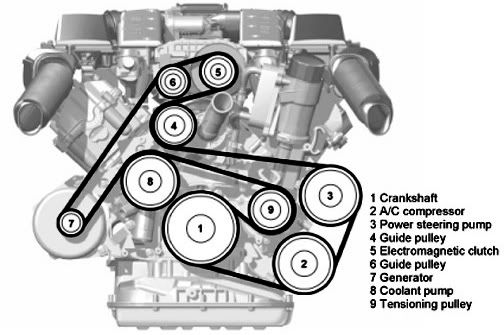
To give credit where it’s due, my dampened evosport ODPS crank pulley is performing splendidly.
-John
It’s a virtual certainty that reducing parasitic losses from the various accessories will improve performance and reduce fuel consumption. Alas, I’ve no first-hand MB knowledge to share. Know you’ve read about their favorable results around here on the M271 and normally-aspirated M112/M113. OT, but they’ve already recouped their modest investment on my blasphemous GMC lumber wagon.
Spoke with another trusted vendor today on your behalf, but seems as if they’re also awaiting delivery.
Perhaps the OP will post an update in due course.
To give credit where it’s due, my dampened evosport ODPS crank pulley is performing splendidly.
-John
Super Moderator
Joined: Jul 2006
Posts: 3,365
Likes: 12
From: Orange County, CA
GMC - Miata - Trek - P-Car
I’ve witnessed that hysteresis phenomenon over the shoulder of a prominent camshaft manufacturer.
It’s akin to watching a snake slither about on hot asphalt – only he survived.
www.spintron.com/vtrain.htm
MBworld Guru
Joined: Apr 2002
Posts: 22,058
Likes: 18
From: Diamond Bar, CA
W206 PHEV AMG


