




ABC hoses

MBWorld Fanatic!
Joined: Aug 2013
Posts: 1,077
Likes: 80
From: Anchorage
05 CL65
Like to know what you mean by "resleeved" as well. My HPE hose is leaking again even though it is less than 2 years old and has less than 15,000 miles on it. I replaced 6 of my hoses last time, but only bought the HPE hose and the main pressure hose from Mercedes. I had the other hoses rebuilt by a local hydraulics shop, but didn't think you could do that with the HPE hose.

Senior Member
Joined: Dec 2015
Posts: 319
Likes: 14
From: chicago
Cl 65
Like to know what you mean by "resleeved" as well. My HPE hose is leaking again even though it is less than 2 years old and has less than 15,000 miles on it. I replaced 6 of my hoses last time, but only bought the HPE hose and the main pressure hose from Mercedes. I had the other hoses rebuilt by a local hydraulics shop, but didn't think you could do that with the HPE hose.
MBWorld Fanatic!
Joined: Aug 2013
Posts: 1,077
Likes: 80
From: Anchorage
05 CL65
I don't recall right now. Going to swing by my dealer and check tomorrow. I usually get parts for between 20-40% off list at my local dealership. Last time I know it was cheaper than anywhere on line by the time I figured in shipping. The three hoses I had made added together cost less than any one I bought from the dealership though.

MBWorld Fanatic!


Joined: Nov 2010
Posts: 2,605
Likes: 343
From: Welwyn, Herts, UK
2006 S600
I didn't stick to any particular make of hose, termination or shop, I just used 10mm compression fittings on 3/8" two wire hose, SAE 100 R2AT hose, same as everything else.
Only thing to watch out for is that the two pump outlet pipes are 12mm, so you need appropriate compression fittings, that's all. Everything else is 10mm.
Failing after two years is pretty back luck. My guess is they may have been installed with a slight twist.
Nick
MB World Stories
The Best of Mercedes & AMG

Manual Mercedes? 6 Times Sindelfingen Let Drivers Have All The Fun
Verdad Gallardo
Mercedes SLR McLaren 722 S Is Extremely Rare Example Modified by McLaren
Verdad Gallardo
8 Classic Boxy Mercedes Designs That Have Aged Like Fine Wine
Verdad Gallardo
Flawlessly Restored Mercedes 190E Evo II Heads to Auction
Verdad Gallardo
Electric Mercedes C-Class Unveiled: 11 Things You Need to Know
Verdad Gallardo
Mercedes EQS Gets A Major Update: Everything You Need to Know
Verdad Gallardo
5 Underrated Mercedes-Benz Models That Don't Get the Love They Deserve
Verdad Gallardo
Mercedes 300D Has Pushed Well Past 1 Million Miles and It Ain't Stopping
Verdad Gallardo
10 Most Reliable Mercedes-Benz Models You Can Buy Used
Verdad Gallardo
MBWorld Fanatic!
Joined: Aug 2013
Posts: 1,077
Likes: 80
From: Anchorage
05 CL65
Nick,
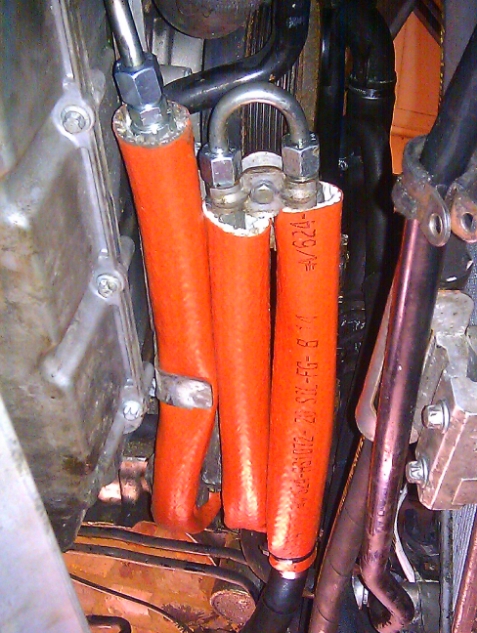
The one that is leaking is the HPE hose that comes off the pump goes back and forth across the front and dead ends. Looks like the final hose between the 180* bend and dead end is what's leaking again. I did all the work myself and that hose doesn't attach to anything on the end so no way to put it under any twist/tension. I just thought that section was a special hose and had to be able to "expand" with pulses from the pump. If I can replace it with standard hydraulic hose that would be a lot cheaper, and easier, than replacing it with a new hose from MB.
The one that is leaking is the HPE hose that comes off the pump goes back and forth across the front and dead ends. Looks like the final hose between the 180* bend and dead end is what's leaking again. I did all the work myself and that hose doesn't attach to anything on the end so no way to put it under any twist/tension. I just thought that section was a special hose and had to be able to "expand" with pulses from the pump. If I can replace it with standard hydraulic hose that would be a lot cheaper, and easier, than replacing it with a new hose from MB.
MBWorld Fanatic!
Joined: Nov 2010
Posts: 2,605
Likes: 343
From: Welwyn, Herts, UK
2006 S600
Matt,
I use compression jointed hoses from a hydraulic shop for ALL of my forward ABC hoses, and I had no performance or reliability problems with any of them. Its not voodoo.
Nick

I use compression jointed hoses from a hydraulic shop for ALL of my forward ABC hoses, and I had no performance or reliability problems with any of them. Its not voodoo.
Nick

MBWorld Fanatic!
Joined: Oct 2009
Posts: 1,924
Likes: 38
cl600
nick, was wondering how you cut the fittings off your abc hoses in order to insert them in compression fittings. what did you use to cut them? i believe the abc fluid is flammable and cutting the steel could cause sparks. also does anyone know the length of the dead end hose minus the fittings, or including the fittings. what i'm after is what length hose with compression fitting i need for the dead end hose. i believe you said 12mm compression fitting, correct.
thanks

thanks

Senior Member
Joined: Dec 2015
Posts: 319
Likes: 14
From: chicago
Cl 65
Question? Has anyone considered making hardlines for the abc thus preventing rupture and weeping? It is expensive and you would have to get the correct bends but it would increase reliability and costly repairs.
MBWorld Fanatic!
Joined: Nov 2010
Posts: 2,605
Likes: 343
From: Welwyn, Herts, UK
2006 S600
nick, was wondering how you cut the fittings off your abc hoses in order to insert them in compression fittings. what did you use to cut them? i believe the abc fluid is flammable and cutting the steel could cause sparks. also does anyone know the length of the dead end hose minus the fittings, or including the fittings. what i'm after is what length hose with compression fitting i need for the dead end hose. i believe you said 12mm compression fitting, correct.
thanks
thanks
Never had any sparks, and I doubt that ABC oil is flammable.
Yes, 12mm fittings for the two pump outlet pipes ONLY.
I'll measure the pipes tonight when I fit my gearbox.
Nick

Newbie
Joined: Apr 2017
Posts: 5
Likes: 0
2006 CL 600
Does anyone have tips on how to get the hose out on an 06 CL that goes from the valve block to the left hand strut? This thing goes up to the radiator and loops around a piece of the frame before going back. I tried pulling it out by the radiator and the hard lines get stuck in the maze of stuff. Even if I did get it out that way, I cant imagine how I'd get it back in. Its #70 on the diagram for reference.
Like a lot of you I'm replacing a bunch of weepy front end hoses including the two high pressure ones. Ive searched the forums and haven't found much on this particular hose. Any help to spare my sanity would be appreciated!
Like a lot of you I'm replacing a bunch of weepy front end hoses including the two high pressure ones. Ive searched the forums and haven't found much on this particular hose. Any help to spare my sanity would be appreciated!

Senior Member


Joined: Jul 2008
Posts: 436
Likes: 64
From: Dartmouth, MA
1967 250SE, 2022 GLC300 2023 EQB300, 2018 AMG GT
Hello all, I have been through this so I will share as much as I have.
First, as much as everybody here wishes that sagging will go away by flushing, rodeo, lifting up and down, etc, IT WILL NOT. As somebody mentioned here by flushing you may actually flush parts of the o-ring making it worse.
Can you continue to drive with this leak? Yes, unlike an Airmatic pump the ABC pump runs continuously anyway so there is no fear of breaking something or running dry. If you do drive like that the condition may get worse, like the car dropping in 5 minutes after stop.
The good news is that you can fix this with a few $. I have done it 6 years ago with 2 jack stands and it doesn't drop even over an entire winter.
1 - Lift the front on jack stands, remove the front left wheel and the wheel well front half cover.
2 - You will see the valve block behind and under the left headlight. Take a picture of the piping to it so you will not make mistakes when assembling.
3 - Remove all the piping and connectors from the valve block. Cap the lines the best you can, you don't want a few quarts of fluid on your floor.
4 - Remove the valve block from the car and take it to your bench.
5 - There are 2 shut-off valves and 2 directional valves, one of each for each front corner. In between the valves on each side there is a plastic clip holding them together. Be very careful when removing that clip, it breaks and cannot be purchased as separate part. Try and slide it towards the top of the valves.
6 - Rotating the valves 45 degrees (not 90) will allow to pull them out. They may need some persuasion, they have been in that position for 10 years.
7 - Now that you have them out, the shorter valves are the shut-off the longer ones are the directional. Usually the culprit is shut-off but since you are already there might as well replace all o-rings. You will see that each o-ring (round in cross section) has one or two (forgot) shoulder rings (square cross section) next to it. Those you don't need to replace (I don't have the part numbers anyway). take pictures of the valves so you don't forget the correct order.
8 - O-rings have a standard. On the Shut-off valve you have N1470-2-015 and N1470-2-016 (I forgot how many of each but you're going to buy a dozen of each anyway). On the directional valve you have N1470-2-013, N1470-2-014, N1470-2-015 and N1470-2-018. N1470 is the material which in this case was a common nitrile but it's been there for 6 years without a problem. If you have access to fancy material o-rings then V0884 or V1475 may last 2000 years.
9 - Buy them from McMaster Carr or some other supplier. Shipping will probably cost you more that the o-rings.
10 - Clean the valve block.
11 - Replace the o-rings, put back the valves in the block using assembly oil or the hydraulic oil from the ABC reservoir.
12 - Do all the connectors and pipes, the wheel.
13 - You can drop the car from the jack stands. Most likely the front will go down.
14 - Start the car and cycle lifting it up a dozen times. The first few times check the fluid level and add if necessary. Do not let that pump run dry. Make sure there are no leaks.
15 - Put back the wheel well cover.
There is a nice DIY with good pictures on a german website or blog but I forgot how I got there.
It may take you a couple of hours but is one of the cheapest way to fix an SL-issue that is feared by most.
First, as much as everybody here wishes that sagging will go away by flushing, rodeo, lifting up and down, etc, IT WILL NOT. As somebody mentioned here by flushing you may actually flush parts of the o-ring making it worse.
Can you continue to drive with this leak? Yes, unlike an Airmatic pump the ABC pump runs continuously anyway so there is no fear of breaking something or running dry. If you do drive like that the condition may get worse, like the car dropping in 5 minutes after stop.
The good news is that you can fix this with a few $. I have done it 6 years ago with 2 jack stands and it doesn't drop even over an entire winter.
1 - Lift the front on jack stands, remove the front left wheel and the wheel well front half cover.
2 - You will see the valve block behind and under the left headlight. Take a picture of the piping to it so you will not make mistakes when assembling.
3 - Remove all the piping and connectors from the valve block. Cap the lines the best you can, you don't want a few quarts of fluid on your floor.
4 - Remove the valve block from the car and take it to your bench.
5 - There are 2 shut-off valves and 2 directional valves, one of each for each front corner. In between the valves on each side there is a plastic clip holding them together. Be very careful when removing that clip, it breaks and cannot be purchased as separate part. Try and slide it towards the top of the valves.
6 - Rotating the valves 45 degrees (not 90) will allow to pull them out. They may need some persuasion, they have been in that position for 10 years.
7 - Now that you have them out, the shorter valves are the shut-off the longer ones are the directional. Usually the culprit is shut-off but since you are already there might as well replace all o-rings. You will see that each o-ring (round in cross section) has one or two (forgot) shoulder rings (square cross section) next to it. Those you don't need to replace (I don't have the part numbers anyway). take pictures of the valves so you don't forget the correct order.
8 - O-rings have a standard. On the Shut-off valve you have N1470-2-015 and N1470-2-016 (I forgot how many of each but you're going to buy a dozen of each anyway). On the directional valve you have N1470-2-013, N1470-2-014, N1470-2-015 and N1470-2-018. N1470 is the material which in this case was a common nitrile but it's been there for 6 years without a problem. If you have access to fancy material o-rings then V0884 or V1475 may last 2000 years.
9 - Buy them from McMaster Carr or some other supplier. Shipping will probably cost you more that the o-rings.
10 - Clean the valve block.
11 - Replace the o-rings, put back the valves in the block using assembly oil or the hydraulic oil from the ABC reservoir.
12 - Do all the connectors and pipes, the wheel.
13 - You can drop the car from the jack stands. Most likely the front will go down.
14 - Start the car and cycle lifting it up a dozen times. The first few times check the fluid level and add if necessary. Do not let that pump run dry. Make sure there are no leaks.
15 - Put back the wheel well cover.
There is a nice DIY with good pictures on a german website or blog but I forgot how I got there.
It may take you a couple of hours but is one of the cheapest way to fix an SL-issue that is feared by most.
Last edited by gafitanu; Aug 9, 2017 at 11:32 AM.


