



E320 straight six or v6 which one is better

Member
Joined: May 2006
Posts: 197
Likes: 0
1997 E320
With all respect, I said an inline design is more ideal than a v. ask any engineer and you'll get the same answer. and keep in mind the inline six is a very old design and it's still right up there with the v6, maybe not all the way but still it's a good and proven design and the power difference is not even noticeable for someone who doesn't race their car. That right there should tell you if they went back and redesigned the I6 you would see much better performance than the v, which is where the cost issues come in.
The inline engines also last much longer than V's (except the head gasket problem of course)
I bought my E320 for the I6 engine.
Like i said I'm biased, I like the inline six, I'm old school, don't take me too seriously
The inline engines also last much longer than V's (except the head gasket problem of course)
I bought my E320 for the I6 engine.
Like i said I'm biased, I like the inline six, I'm old school, don't take me too seriously

MBWorld Fanatic!
Joined: Apr 2007
Posts: 6,171
Likes: 16
300E a couple 1994 w124wagon E320 Wagon/,1971MGB Track/Rally, MG Midget Autocross ,2000 E320 wagon.
I
always say they are both great engines,each has it's own merits
in making a choice of w210's It is much easier to find low mile fine examples of the 112 and 113 motors than it is to find a m104 jet engine with low miles
chrysler did a lot of things to drag down mercedes,the modular engine was not one of them.
keep them in good shape and all Mercedes engines are worthy of praise

in making a choice of w210's It is much easier to find low mile fine examples of the 112 and 113 motors than it is to find a m104 jet engine with low miles
chrysler did a lot of things to drag down mercedes,the modular engine was not one of them.
keep them in good shape and all Mercedes engines are worthy of praise

MBWorld Fanatic!
Joined: Dec 2006
Posts: 4,949
Likes: 39
From: Clifton, NJ
96 and 08 911 turbos
With all respect, I said an inline design is more ideal than a v. ask any engineer and you'll get the same answer. and keep in mind the inline six is a very old design and it's still right up there with the v6, maybe not all the way but still it's a good and proven design and the power difference is not even noticeable for someone who doesn't race their car. That right there should tell you if they went back and redesigned the I6 you would see much better performance than the v, which is where the cost issues come in.
The inline engines also last much longer than V's (except the head gasket problem of course)
I bought my E320 for the I6 engine.
Like i said I'm biased, I like the inline six, I'm old school, don't take me too seriously
The inline engines also last much longer than V's (except the head gasket problem of course)
I bought my E320 for the I6 engine.
Like i said I'm biased, I like the inline six, I'm old school, don't take me too seriously
oh for the love of god. The inline 6 has its own issues (ever see what happens to a crank and cams that long?)
The inline 6 is going to last longer? why? The v6 is not exactly very stressed. You have no basis in fact for your statements, just your longing for "the good old days".

Senior Member
Joined: Apr 2007
Posts: 278
Likes: 0
1997 s320, 1997 e320
oh for the love of god. The inline 6 has its own issues (ever see what happens to a crank and cams that long?)
The inline 6 is going to last longer? why? The v6 is not exactly very stressed. You have no basis in fact for your statements, just your longing for "the good old days".
The inline 6 is going to last longer? why? The v6 is not exactly very stressed. You have no basis in fact for your statements, just your longing for "the good old days".

MBWorld Fanatic!
Joined: Oct 2006
Posts: 3,642
Likes: 13
From: Caribbean/Florida/Colorado
E-ZGO 53hp., 1999 E 430 sport, 2004 E 55, 2008 Tahoe LTZ on 24"s
Here is yet another mild turbo I6, not in the 600+ HP. club, but nicely done.
I just don't see many V6 mods other than a pulley on the C32 AMG.
https://mbworld.org/forums/e-class-w124/198814-finally-tt-install-pix.html
I just don't see many V6 mods other than a pulley on the C32 AMG.
https://mbworld.org/forums/e-class-w124/198814-finally-tt-install-pix.html

MBWorld Fanatic!


Joined: Sep 2005
Posts: 6,189
Likes: 242
From: Albuquerque
'10 CL550, '12 GL550
And, the engineer will tell you that the inline engine is a safety hazard as compared to a V engine as regards front-end collision crash worthiness.
Yes, the ideal V6 engine would be a 60-degree, 120-degree, or 180-degree design, but if you're going to use same tooling to make a V8 you compromise on 90-degrees and add a balancer shaft. This stuff seems to make little difference these days, however, as for example the current V6 and V8 Mercedes diesel engines are both 75-degree designs, both with balancer shafts.
In the recent "turbo" era in Formula One, the engines were V6s. Inline engines would have created handling nightmares.
The added expense of having two versus one cylinder heads with the accompanying cam drive complications seems well worth it given the other advantages. Porsche's been doing it for years. BMW's inline engines are these days just marketing, although as noted previously it does permit "modularization" with inline fours.
MBWorld Fanatic!
Joined: Dec 2006
Posts: 4,949
Likes: 39
From: Clifton, NJ
96 and 08 911 turbos
there is a lot of mb i6's on the road with over 300-400k miles still running strong. the v6 has been out for a lot less years, and has more problems (harmonic balancer, oil consumption, sludge, cps etc), while the i6 only major problem is the oil leak after 100+k miles usually, which doesn;t affect performance at all and can be fixed. time will tell. by the way mb mechanics will tell you that the v6 is not as bulletproof as the previous i6. it is still a great engine, don't get me wrong.
My point is that the actual mechanics of the v6 should be just as good as the I6.

MBWorld Fanatic!
Joined: Aug 2003
Posts: 3,927
Likes: 0
From: Vancouver, B.C.
2002 E55 AMG
The V6 in my now sold E320 was completely problem free. I have to agree with OliverK and ikchris's points as they are true.
The sludge problem was due to owners not using synthetic oil in the first batch of engines because MB never told them to.
I would also think the reason why the W140 never used the M112 was because it wouldn't be worth making all the changes when it was about to be phased out (last year for the W140 was 1999).
The sludge problem was due to owners not using synthetic oil in the first batch of engines because MB never told them to.
I would also think the reason why the W140 never used the M112 was because it wouldn't be worth making all the changes when it was about to be phased out (last year for the W140 was 1999).
MB World Stories
The Best of Mercedes & AMG

Manual Mercedes? 6 Times Sindelfingen Let Drivers Have All The Fun
Verdad Gallardo
Mercedes SLR McLaren 722 S Is Extremely Rare Example Modified by McLaren
Verdad Gallardo
8 Classic Boxy Mercedes Designs That Have Aged Like Fine Wine
Verdad Gallardo
Flawlessly Restored Mercedes 190E Evo II Heads to Auction
Verdad Gallardo
Electric Mercedes C-Class Unveiled: 11 Things You Need to Know
Verdad Gallardo
Mercedes EQS Gets A Major Update: Everything You Need to Know
Verdad Gallardo
5 Underrated Mercedes-Benz Models That Don't Get the Love They Deserve
Verdad Gallardo
Mercedes 300D Has Pushed Well Past 1 Million Miles and It Ain't Stopping
Verdad Gallardo
10 Most Reliable Mercedes-Benz Models You Can Buy Used
Verdad Gallardo
Member
Joined: May 2006
Posts: 197
Likes: 0
1997 E320
oh for the love of god. The inline 6 has its own issues (ever see what happens to a crank and cams that long?)
The inline 6 is going to last longer? why? The v6 is not exactly very stressed. You have no basis in fact for your statements, just your longing for "the good old days".
The inline 6 is going to last longer? why? The v6 is not exactly very stressed. You have no basis in fact for your statements, just your longing for "the good old days".

Sure, the shorter cams and crank shaft will have to bear less stress but guess what, they are also made to bear less stress which means: they're CHEAPER to make (cheaper steel, cheaper to machine, etc). are you telling me that the engineers who designed for mercedes (and we're talking good old genuine mercedes) were that stupid to not think about the stress on the components? please if you don't have respect for me have a little respect for those engineers that made mercedes benz one of the best car makers in the world in the "good old days". and look at Benz's reputation now: listed in the worst rated cars list. Thank you, I rest my case.
Just because an engine looks new and runs like new because it IS new doesn't mean it's a better design. only time will tell.
Let's face it. Mercedes leaned a little too far to the economic side of car production in the past decade.
The design of a car is balanced result of: cost vs performance and quality.
Knowing the above, explain to me how a brand new E class cost 50,000 in 1997 and now in 2007 (10 years later, after inflation and prices rising) it's still in the same range?
Thank you.
Member
Joined: May 2006
Posts: 197
Likes: 0
1997 E320
You're right about the Formula 1. An engine rotating at 10,000 and higher rpm is going to have a lot of angular momentum which will cause trouble in handling. But you're talking about a racing engine not a daily driver with a little edge to it.
MBWorld Fanatic!
Joined: Sep 2005
Posts: 6,189
Likes: 242
From: Albuquerque
'10 CL550, '12 GL550

Senior Member
Joined: Dec 2004
Posts: 484
Likes: 1
From: orange county, CA
Tesla Roadster Sport
The main reason the V6 was designed was so that it could be a multi-platform engine. The inline 6 is inherently balanced and less complicated (fewer major parts) than a V6. The I6 is also more efficient in that you have less frictional losses due to its simple layout (i.e. cylinder head, valve design etc). Remember, that in a V6 that there is a lot of duplication. The main benefit for the V6 engines is size, cost, and the ability to spawn new engines from a single tooling platform.
When the V6's came out Mercedes was trying to recapture market share (and still is) the only way to do it was to offer more choices in vehicles. Thus they had to cost cut with the SOHC engines (notice how now they have went back to a DOHC so they can implement advanced VVT). The V6 paired with the SOHC provides great economy, but in the whole scheme of things it is (and even when it came out) a very uninspiring design. There is nothing great about that engine.
When the V6's came out Mercedes was trying to recapture market share (and still is) the only way to do it was to offer more choices in vehicles. Thus they had to cost cut with the SOHC engines (notice how now they have went back to a DOHC so they can implement advanced VVT). The V6 paired with the SOHC provides great economy, but in the whole scheme of things it is (and even when it came out) a very uninspiring design. There is nothing great about that engine.
Last edited by husk323; Dec 21, 2007 at 11:14 PM.

Almost a Member!
Joined: Jul 2006
Posts: 36
Likes: 0
Mercedes C280
The main reason the V6 was designed was so that it could be a multi-platform engine. The inline 6 is inherently balanced and less complicated (fewer major parts) than a V6. The I6 is also more efficient in that you have less frictional losses due to its simple layout (i.e. cylinder head, valve design etc). Remember, that in a V6 that there is a lot of duplication. The main benefit for the V6 engines is size, cost, and the ability to spawn new engines from a single tooling platform.
When the V6's came out Mercedes was trying to recapture market share (and still is) the only way to do it was to offer more choices in vehicles. Thus they had to cost cut with the SOHC engines (notice how now they have went back to a DOHC so they can implement advanced VVT). The V6 paired with the SOHC provides great economy, but in the whole scheme of things it is (and even when it came out) a very uninspiring design. There is nothing great about that engine.
When the V6's came out Mercedes was trying to recapture market share (and still is) the only way to do it was to offer more choices in vehicles. Thus they had to cost cut with the SOHC engines (notice how now they have went back to a DOHC so they can implement advanced VVT). The V6 paired with the SOHC provides great economy, but in the whole scheme of things it is (and even when it came out) a very uninspiring design. There is nothing great about that engine.
This shows that you have not read up enough about the M112 V6 and driven the later model W202s and W210s powered by this V6 engine. Firstly the V6 layout gives engineers more room to work on, on safety isssues. And yes its true that the M112 V6 is an SOHC engine, but that does not make it less powerful. In fact it produces about 3 extra kilowatts more at 165 kw vs the 162 kw power output of the Straight 6. Still both are great engines of their respective generation. The M112 V6 produces 85% of its maximum torque at just 2000 rpm, and has a completely flat torque curve above 3000 rpm. This gives the car a very torquey feel, with a nice ammount of power to go along with it. The M104 is not capable of that, and feels heavier having a cast iron block. You should drive a later model E-Class with the M112 V6 under the bonnet and compare it to another E320 powered by the Straight 6 before passing a judgment.
Last edited by SechsPackSound; Dec 22, 2007 at 03:44 AM.
MBWorld Fanatic!
Joined: Apr 2007
Posts: 6,171
Likes: 16
300E a couple 1994 w124wagon E320 Wagon/,1971MGB Track/Rally, MG Midget Autocross ,2000 E320 wagon.
Besides
when the V platform came out in 98(having been in the production and design pipeline for 5 years)Mercedes owned the market,the introduction of the new E class only solidified their position with the highest sales in their history.The V modular engine is the most highly awarded engine in Mercedes history.
Stiff competition from other makers and the poor quality/cost controls were and still are the reason they are scrambling to regain the lead they once enjoyed.
Simple,cheap,uninspired?http://www.whnet.com/4x4/new_V6.html
That's what i heard in the 60's about the small block chevy and 40 years later it is pushing out 640 h.p. in its latest "uninspired" iteration and the V platform on the mercedes will still be kicking long after the last L-6 springs an oil leak.
Stiff competition from other makers and the poor quality/cost controls were and still are the reason they are scrambling to regain the lead they once enjoyed.
Simple,cheap,uninspired?http://www.whnet.com/4x4/new_V6.html
That's what i heard in the 60's about the small block chevy and 40 years later it is pushing out 640 h.p. in its latest "uninspired" iteration and the V platform on the mercedes will still be kicking long after the last L-6 springs an oil leak.
MBWorld Fanatic!
Joined: Dec 2006
Posts: 4,949
Likes: 39
From: Clifton, NJ
96 and 08 911 turbos
Um... right... and you have basis to prove that the inline 6 is stressed and the v6 isn't. Well, let's see the stress analysis that you have to support "the v6 is not exactly very stressed". wow, how profound.
Sure, the shorter cams and crank shaft will have to bear less stress but guess what, they are also made to bear less stress which means: they're CHEAPER to make (cheaper steel, cheaper to machine, etc). are you telling me that the engineers who designed for mercedes (and we're talking good old genuine mercedes) were that stupid to not think about the stress on the components? please if you don't have respect for me have a little respect for those engineers that made mercedes benz one of the best car makers in the world in the "good old days". and look at Benz's reputation now: listed in the worst rated cars list. Thank you, I rest my case.
Just because an engine looks new and runs like new because it IS new doesn't mean it's a better design. only time will tell.
Let's face it. Mercedes leaned a little too far to the economic side of car production in the past decade.
The design of a car is balanced result of: cost vs performance and quality.
Knowing the above, explain to me how a brand new E class cost 50,000 in 1997 and now in 2007 (10 years later, after inflation and prices rising) it's still in the same range?
Thank you.
Sure, the shorter cams and crank shaft will have to bear less stress but guess what, they are also made to bear less stress which means: they're CHEAPER to make (cheaper steel, cheaper to machine, etc). are you telling me that the engineers who designed for mercedes (and we're talking good old genuine mercedes) were that stupid to not think about the stress on the components? please if you don't have respect for me have a little respect for those engineers that made mercedes benz one of the best car makers in the world in the "good old days". and look at Benz's reputation now: listed in the worst rated cars list. Thank you, I rest my case.
Just because an engine looks new and runs like new because it IS new doesn't mean it's a better design. only time will tell.
Let's face it. Mercedes leaned a little too far to the economic side of car production in the past decade.
The design of a car is balanced result of: cost vs performance and quality.
Knowing the above, explain to me how a brand new E class cost 50,000 in 1997 and now in 2007 (10 years later, after inflation and prices rising) it's still in the same range?
Thank you.
As for your statement about quality, MBs from the 80s didn't have nearly the same technology, features, options or HP, that the new ones do, hence they are prone to less problems. While MB had a few bad years, the complaints about the modular engines was limited to very early years.
The I6 is a great engine, but there is nothing wrong with the V6.
To say one is better than the other is silly. However, the V6 makes more power and torque, and there is no concrete evidence to show that its longevity is in question.
Senior Member
Joined: Dec 2004
Posts: 484
Likes: 1
From: orange county, CA
Tesla Roadster Sport
This shows that you have not read up enough about the M112 V6 and driven the later model W202s and W210s powered by this V6 engine. Firstly the V6 layout gives engineers more room to work on, on safety isssues. And yes its true that the M112 V6 is an SOHC engine, but that does not make it less powerful. In fact it produces about 3 extra kilowatts more at 165 kw vs the 162 kw power output of the Straight 6. Still both are great engines of their respective generation. The M112 V6 produces 85% of its maximum torque at just 2000 rpm, and has a completely flat torque curve above 3000 rpm. This gives the car a very torquey feel, with a nice ammount of power to go along with it. The M104 is not capable of that, and feels heavier having a cast iron block. You should drive a later model E-Class with the M112 V6 under the bonnet and compare it to another E320 powered by the Straight 6 before passing a judgment.
 >) It makes it complicated to add VVT, and the only way to get power is to add boost. The M104 is torquey as well, you should take a theory class on how an engine works at your local community college. Most of your statements are based on "what you feel" rather than facts.
Senior Member
Joined: Dec 2004
Posts: 484
Likes: 1
From: orange county, CA
Tesla Roadster Sport
when the V platform came out in 98(having been in the production and design pipeline for 5 years)Mercedes owned the market,the introduction of the new E class only solidified their position with the highest sales in their history.The V modular engine is the most highly awarded engine in Mercedes history.
Stiff competition from other makers and the poor quality/cost controls were and still are the reason they are scrambling to regain the lead they once enjoyed.
Simple,cheap,uninspired?http://www.whnet.com/4x4/new_V6.html
That's what i heard in the 60's about the small block chevy and 40 years later it is pushing out 640 h.p. in its latest "uninspired" iteration and the V platform on the mercedes will still be kicking long after the last L-6 springs an oil leak.
Stiff competition from other makers and the poor quality/cost controls were and still are the reason they are scrambling to regain the lead they once enjoyed.
Simple,cheap,uninspired?http://www.whnet.com/4x4/new_V6.html
That's what i heard in the 60's about the small block chevy and 40 years later it is pushing out 640 h.p. in its latest "uninspired" iteration and the V platform on the mercedes will still be kicking long after the last L-6 springs an oil leak.
Only problem is the M112 has the "crippled" v6 with a SOHC, if this engine was designed to be a top of the line engine how come they did not design it with 4 cam shafts? It was obviously designed for economy, to reduce the cost of engine development, and ease of maufacturing. Once Mercedes realized (market forces BMW, Lexus,Audi etc and with the AMG Models) that people wanted performance they ditched the SOHC went to DOHC and ditched the Cylinder De-activation system etc. This motor by no means was a no-cost barred motor, it was designed to be Mercedes' cross platform "generic" motor. Its a great reliable motor, but its design is far from groundbreaking.
MBWorld Fanatic!
Joined: Apr 2007
Posts: 6,171
Likes: 16
300E a couple 1994 w124wagon E320 Wagon/,1971MGB Track/Rally, MG Midget Autocross ,2000 E320 wagon.
the
m112 does not have cylinder deactivation.It is the most awarded engine in mercedes history.It hands down generates more power and torque then the L-6.
Variable intake runners,3 valve cylinders,multi spark coils,etc. were a far cry from the technology used on the m104 engine so in that aspect compared to the tractor motor -Yes it is groundbreaking.
Variable intake runners,3 valve cylinders,multi spark coils,etc. were a far cry from the technology used on the m104 engine so in that aspect compared to the tractor motor -Yes it is groundbreaking.
Senior Member
Joined: Dec 2004
Posts: 484
Likes: 1
From: orange county, CA
Tesla Roadster Sport
m112 does not have cylinder deactivation.It is the most awarded engine in mercedes history.It hands down generates more power and torque then the L-6.
Variable intake runners,3 valve cylinders,multi spark coils,etc. were a far cry from the technology used on the m104 engine so in that aspect compared to the tractor motor -Yes it is groundbreaking.
Variable intake runners,3 valve cylinders,multi spark coils,etc. were a far cry from the technology used on the m104 engine so in that aspect compared to the tractor motor -Yes it is groundbreaking.
Your E320 has 232 lb ft of torque, the SL320 has 232lb ft of torque, so how is that hands down more torque? You are talking non-sense. 3 valves per cylinder, how is that ground breaking when Audi had 5 valves per cylinder and 4 valves per cylinder were the norm? Your motor doesnt even have VVT, now that is embarassing.
MBWorld Fanatic!
Joined: Apr 2007
Posts: 6,171
Likes: 16
300E a couple 1994 w124wagon E320 Wagon/,1971MGB Track/Rally, MG Midget Autocross ,2000 E320 wagon.
In comparison
to the outdated m104 motor it is groundbreaking,is the point.You drifted so far off the point of contention you are in left field.The v-6 and v-8 are both better platforms for the e series.Engine for engine ,forget about throwing in red herrings like vvt or multi cams,the v modular is the better engine.
Kept on the subject,no nonsense,no throwing in comparissons to newer engines,apples for apples the v-6 alum block is light years ahead of the 1950's technology employed in the l-6 engine.
Kept on the subject,no nonsense,no throwing in comparissons to newer engines,apples for apples the v-6 alum block is light years ahead of the 1950's technology employed in the l-6 engine.
Almost a Member!
Joined: Jul 2006
Posts: 36
Likes: 0
Mercedes C280
I have driven late model M112's. Obviously your comprehension skills are lacking. The main reason Mercedes went to a SOHC on the V6's was for fuel economy purposes. The top end in terms of performance is significantly less from a SOHC than it is for a DOHC. Compare the old V6 vs the new V6 (how is sohc not less powerful>) It makes it complicated to add VVT, and the only way to get power is to add boost. The M104 is torquey as well, you should take a theory class on how an engine works at your local community college. Most of your statements are based on "what you feel" rather than facts.
>) It makes it complicated to add VVT, and the only way to get power is to add boost. The M104 is torquey as well, you should take a theory class on how an engine works at your local community college. Most of your statements are based on "what you feel" rather than facts.Last edited by SechsPackSound; Dec 22, 2007 at 09:55 PM.
Senior Member
Joined: Dec 2004
Posts: 484
Likes: 1
From: orange county, CA
Tesla Roadster Sport
And again you've passed a judgment without reading up appropriate facts. Also I did not discredit the Straight 6 like how you put it. What I meant was that the Straight 6 is not capable of producing 85% of its maximum torque at just 2000 rpm, while having a completely flat torque curve above 3000 rpm. The Straight 6 just does not have the same feel and lightness as specified. You should read up the facts. Read the following articles and you'll know what I'm talking about ----> http://www.eclassbenz.com/node/33 . Also the fact that the M112 is based on the SOHC and three valves per cylinder does not make it less powerful or less efficient. ----> http://www.whnet.com/4x4/new_V6.html
MBWorld Fanatic!
Joined: Apr 2007
Posts: 6,171
Likes: 16
300E a couple 1994 w124wagon E320 Wagon/,1971MGB Track/Rally, MG Midget Autocross ,2000 E320 wagon.
I think
what we have here is another tommyboy.Arguing Against the facts that the v-6 out of the same 195 cu.in engine with 1 large exhaust valve instead of two small ones makes more power then the antiquated L-6 engine and at the same time achieves better mileage and lower emissions.The new LS9 corvette engine with 640 h.p. is only 2 valves per cylinder and is the most advanced engine in gm history.which proves you don't need 4 or 5 valves to produce power.
A properly designed head with 1 large exhaust valve in the proper path will out flow the obstructed path of two small valves and the shrouding they exhibit to the path of the exhaust gases. More complex and more valves and more cams does not always make a more powerful engine,and that is not feel that is facts.
1999 v-6 0-60 7.2 seconds
1997 L-6 0-60 7.9 seconds
feel?my ***!that's lengths,that's facts.
case closed
A properly designed head with 1 large exhaust valve in the proper path will out flow the obstructed path of two small valves and the shrouding they exhibit to the path of the exhaust gases. More complex and more valves and more cams does not always make a more powerful engine,and that is not feel that is facts.
1999 v-6 0-60 7.2 seconds
1997 L-6 0-60 7.9 seconds
feel?my ***!that's lengths,that's facts.
case closed
MBWorld Fanatic!
Joined: Oct 2006
Posts: 3,642
Likes: 13
From: Caribbean/Florida/Colorado
E-ZGO 53hp., 1999 E 430 sport, 2004 E 55, 2008 Tahoe LTZ on 24"s
[QUOTE=lkchris;2558705]No, the engineer will tell you the crankshaft is too long, especially if you're talking about a straight 8.
Yes, the ideal V6 engine would be a 60-degree, 120-degree, or 180-degree design, QUOTE]
Here is the "Better" short crankshaft.
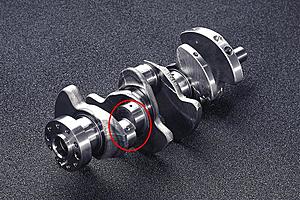
This is award winning engineering?????
And by the time an engine gets to 180 it is no longer a V, now they call it horizontally opposed, flat, boxer, pancake, suitcase. and it's characteristics are closer to an I6 than a V6 in that, it has a real crank, and can be balanced.
Yes, the ideal V6 engine would be a 60-degree, 120-degree, or 180-degree design, QUOTE]
Here is the "Better" short crankshaft.

This is award winning engineering?????
And by the time an engine gets to 180 it is no longer a V, now they call it horizontally opposed, flat, boxer, pancake, suitcase. and it's characteristics are closer to an I6 than a V6 in that, it has a real crank, and can be balanced.


