



Towing and tires

Thread Starter
Member
Joined: Mar 2016
Posts: 87
Likes: 6
2010 GL350
Towing and tires
So I am literally dictating this as I drive. Towing my Airstream from Miami to Vermont and I just had to replace two tires in Jacksonville Florida. The only tires the right size were michelins. I have always used the Bridgestone Dueler since the original Goodyear.
The michelins are not run Flats. That's okay because I think it's easier to pull out a nail and plug the tire and it is to change the tire.
but here's my problem. For the first time ever, I feel like I need sway bars. When the cruise control is on, it starts swaying enough that the onboard computer selectively brakes certain tires because the ESP kicks in.
I have been Towing this trailer for almost 4 years and I never before had a problem with Sway. And it's not even windy right now. could the Michelin sidewalls be that much less stiff that the rear end sway's that much more?
apologies for the weird capitalization in this message, but that's what you get for hands-free dictation
The michelins are not run Flats. That's okay because I think it's easier to pull out a nail and plug the tire and it is to change the tire.
but here's my problem. For the first time ever, I feel like I need sway bars. When the cruise control is on, it starts swaying enough that the onboard computer selectively brakes certain tires because the ESP kicks in.
I have been Towing this trailer for almost 4 years and I never before had a problem with Sway. And it's not even windy right now. could the Michelin sidewalls be that much less stiff that the rear end sway's that much more?
apologies for the weird capitalization in this message, but that's what you get for hands-free dictation
Thread Starter
Member
Joined: Mar 2016
Posts: 87
Likes: 6
2010 GL350
I should mention that the new michelins went on the rear. The rear suspension is in good shape. All replaced with arnott in the last 6 months.
if I had not driven the first half of today with zero problems, I would not be so quick to attribute it to the tires. But that's all that has changed. Unless they did something to the suspension when they replaced the tires
if I had not driven the first half of today with zero problems, I would not be so quick to attribute it to the tires. But that's all that has changed. Unless they did something to the suspension when they replaced the tires
Super Member


Joined: Apr 2016
Posts: 889
Likes: 148
From: Southern Illinois
, 2023 BMW X4, 1991 190E
Can't answer your problem, but you did the right thing by putting the new tires on the rear and on the same axle. I would make sure they have the same air pressue could be critical in this case. Not sure what pressure you run, but it should be on the high side. Keep us posted, this is scary.

MBWorld Fanatic!
Joined: May 2015
Posts: 1,932
Likes: 291
From: Allentown, PA
'08 GL 320 CDI
Yeah, as you know, that amount of sway should NOT be happening. The fact that they are Michelins is not the issue. Tires are an often "heated" debate about which is best, but Michelins are fine tires by any standards. Thoughts that come to mind that could explain it...
-- Damage to rear OR front suspension
-- The "wrong" Michelin... a passenger car tire (lighter duty), for example, that doesn't have the proper load rating
-- Air pressure... but since it sounds like you do a decent amount of towing I'm sure you're on top of that one
-- Something on the trailer end... tire issues, suspension issues.
-- Did you change the load arrangement in the trailer? Meaning, do you have too much weight in the back of the trailer, thereby giving too little tongue weight?
-- Damage to rear OR front suspension
-- The "wrong" Michelin... a passenger car tire (lighter duty), for example, that doesn't have the proper load rating
-- Air pressure... but since it sounds like you do a decent amount of towing I'm sure you're on top of that one
-- Something on the trailer end... tire issues, suspension issues.
-- Did you change the load arrangement in the trailer? Meaning, do you have too much weight in the back of the trailer, thereby giving too little tongue weight?
Thread Starter
Member
Joined: Mar 2016
Posts: 87
Likes: 6
2010 GL350
Thank you Dennis for your quick reply. I would have considered a private message to you and crusty custom, but I did not think I could manage a PM while driving and dictating. Especially when I was being dragged all over the road by my trailer. Maybe one day we will set up a new thread on this forum for Mercedes diesel owners who tow airstreams.
You are right that I'm religious about tire pressure and also weight and balance. What I cannot figure out, because this is almost a perfect experiment where you drive 300 miles with one set of tires, and then swap out your rear tires for a new set of tires and drive another 300 miles, is what else could have changed.
I will say, that after 40 or 50 miles, it got a little better. Still not as good as it used to be. But is it possible that either the airmatic suspension, or the arnott struts, have some kind of memory lag? And having been up on a lift with the frame dangling from the chassis, then going immediately to 500 lb on the tongue, could that have taken a while to equalize?
You are right that I'm religious about tire pressure and also weight and balance. What I cannot figure out, because this is almost a perfect experiment where you drive 300 miles with one set of tires, and then swap out your rear tires for a new set of tires and drive another 300 miles, is what else could have changed.
I will say, that after 40 or 50 miles, it got a little better. Still not as good as it used to be. But is it possible that either the airmatic suspension, or the arnott struts, have some kind of memory lag? And having been up on a lift with the frame dangling from the chassis, then going immediately to 500 lb on the tongue, could that have taken a while to equalize?
Trending Topics
MB World Stories
The Best of Mercedes & AMG

Manual Mercedes? 6 Times Sindelfingen Let Drivers Have All The Fun
Verdad Gallardo
Mercedes SLR McLaren 722 S Is Extremely Rare Example Modified by McLaren
Verdad Gallardo
8 Classic Boxy Mercedes Designs That Have Aged Like Fine Wine
Verdad Gallardo
Flawlessly Restored Mercedes 190E Evo II Heads to Auction
Verdad Gallardo
Electric Mercedes C-Class Unveiled: 11 Things You Need to Know
Verdad Gallardo
Mercedes EQS Gets A Major Update: Everything You Need to Know
Verdad Gallardo
5 Underrated Mercedes-Benz Models That Don't Get the Love They Deserve
Verdad Gallardo
Mercedes 300D Has Pushed Well Past 1 Million Miles and It Ain't Stopping
Verdad Gallardo
10 Most Reliable Mercedes-Benz Models You Can Buy Used
Verdad Gallardo
MBWorld Fanatic!
Joined: May 2015
Posts: 1,932
Likes: 291
From: Allentown, PA
'08 GL 320 CDI
Yeah, if you didn't mess with the trailer then it is a good experiment as it sounds like the only variable is the tires. I'm not aware of any type of "memory" for the suspension, in fact it's "supposed" to be able to adjust quickly to different conditions. If you've verified that they are the correct tires/load rating, then tires should be fine... unless there's a defect or possibly not balanced? But I'm surprised to hear that things got better. Could you have something (mud for example) stuck inside either one of the car's wheels or the trailer's wheels? The only other thing would be "something else" that just happened to fail at the same time... but that wouldn't get better.
Have you tried a high speed run without the trailer? Anything obviously wrong (with any tires) visually?
Be safe!
Have you tried a high speed run without the trailer? Anything obviously wrong (with any tires) visually?
Be safe!
Last edited by DennisG01; May 29, 2018 at 08:50 AM.
MBWorld Fanatic!


Joined: Sep 2005
Posts: 6,189
Likes: 242
From: Albuquerque
'10 CL550, '12 GL550
Thoughts ...
since it’s full time 4wd, the recommendation is always same tire on all 4 wheels
runflat tires certainly have stiffer sidewalls than normal tires ... you can drive on them after all
since it’s full time 4wd, the recommendation is always same tire on all 4 wheels
runflat tires certainly have stiffer sidewalls than normal tires ... you can drive on them after all


Thread Starter
Member
Joined: Mar 2016
Posts: 87
Likes: 6
2010 GL350
1. Two new Michelin Premier LTX on rear, replaced Bridgestone Duelers run flats at 50% tread. Bridgestones still on front with 75% tread.
2. I have traditionally run 36/37 rear and 33/34 front. Cold pressure. As tires warm up, pressure increases by about 4psi.
3. Michelin Premier Latitude LTX has exact same load and speed rating as Bridgestone: 109H.
3. After tire change, shop inflated all to 36psi cold. I checked with quality gauge, and confirmed on instrument panel as soon as I started driving.
4. Back on I-95, noticed immediate difference in sway and fishtail. What used to be smooth at 70, was now squirrelly at 65.
5. Seemed to improve slightly over the next hour, but by no means back to where it was.
6. 2nd day tried shifting some stuff in trailer to add tongue weight, to little or no effect.
7. Last day increased rear pressure to 40psi cold, 44/45 after warm up, and notice some improvement. Still not as good as before.
8. I will get a chance to do some high speed driving without the trailer tomorrow, and see how it handles.
I don't think I was light on the tongue because shifting weight forward made no difference. The minor improvement I noticed in the hour after the tire change that first day was probably just the tires warming up. The bottom line to me is the Michelins seem to need higher pressure because the sidewall is not as stiff. Maybe unloaded they handle better because of that.
The fact that the two different brands have the same load rating is not the same thing as saying they handle the same load equally well.
One final thought... I spent the 2nd night with a friend who runs a large landscape and tree service, often towing heavy trailers with F250s and 350s. He swears that when they put new tires on a truck, the trailers are more prone to sway. He attributes it to the increased tread height on the new tires. Seems to me that a half inch wouldn't make that much difference, but I'm passing along his opinion FWIW.
MBWorld Fanatic!
Joined: May 2015
Posts: 1,932
Likes: 291
From: Allentown, PA
'08 GL 320 CDI
I agree with your mechanic that brand new tires can feel a little different than worn tires in terms of sway. I would use the word "softer" feeling, myself - meaning you can feel JUST a little bit of sway, but I've also found that it either completely goes away or I get used to it. Regardless, I have NEVER felt anything to the extent of where the truck starts cutting in with anti-sway controls. Not even close.
I can't say one way or the other as I don't know, but could the slight difference in height from front to back be messing with the computer? Same question for run flats on front and normal tires on rear. It would have to be awful darn sensitive for that to be happening.
But, for fear of repeating myself, there is NO WAY that those tires (assuming no defects) are inferior in any way to run flats. Yes, the sidewalls are not as stiff, but that has zero to do with their load capacity.
4,500lbs is no big deal. I tow heavier than that with a couple different boats... and I DO NOT use anti-sway bars as it's REALLY hard to get them to work properly with the surge braking system on the boat trailers.
I can't say one way or the other as I don't know, but could the slight difference in height from front to back be messing with the computer? Same question for run flats on front and normal tires on rear. It would have to be awful darn sensitive for that to be happening.
But, for fear of repeating myself, there is NO WAY that those tires (assuming no defects) are inferior in any way to run flats. Yes, the sidewalls are not as stiff, but that has zero to do with their load capacity.
4,500lbs is no big deal. I tow heavier than that with a couple different boats... and I DO NOT use anti-sway bars as it's REALLY hard to get them to work properly with the surge braking system on the boat trailers.

Senior Member
Joined: Feb 2011
Posts: 350
Likes: 106
From: Palo Alto, CA
2011 GL 350, P1 Package, HID headlamps, Blind spot assist, Parktronic, Wood steering wheel
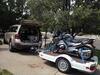
Finally arrived in Vermont and managed to unclench my hands from the steering wheel. Thanks for everyone's comments and suggestions, Here is a recitation of facts and then my observations and some opinion. Not trying to start a firestorm about which tires are "better".. Background is I use at 2010 GL350 to tow a 1968 airstream recently weighed at 4550lbs and tongue weight 500. Airstream has 3 year old Dexter axles and new tires and rims. Not using any WD or anti-sway hitch. Rear airbags and shocks replaced in last 12 months. Fronts replaced about 24 months ago. All Arnott. Shredded a rear tire in Jacksonville ater 350 miles of highway towing.
1. Two new Michelin Premier LTX on rear, replaced Bridgestone Duelers run flats at 50% tread. Bridgestones still on front with 75% tread.
2. I have traditionally run 36/37 rear and 33/34 front. Cold pressure. As tires warm up, pressure increases by about 4psi.
3. Michelin Premier Latitude LTX has exact same load and speed rating as Bridgestone: 109H.
3. After tire change, shop inflated all to 36psi cold. I checked with quality gauge, and confirmed on instrument panel as soon as I started driving.
4. Back on I-95, noticed immediate difference in sway and fishtail. What used to be smooth at 70, was now squirrelly at 65.
5. Seemed to improve slightly over the next hour, but by no means back to where it was.
6. 2nd day tried shifting some stuff in trailer to add tongue weight, to little or no effect.
7. Last day increased rear pressure to 40psi cold, 44/45 after warm up, and notice some improvement. Still not as good as before.
8. I will get a chance to do some high speed driving without the trailer tomorrow, and see how it handles.
I don't think I was light on the tongue because shifting weight forward made no difference. The minor improvement I noticed in the hour after the tire change that first day was probably just the tires warming up. The bottom line to me is the Michelins seem to need higher pressure because the sidewall is not as stiff. Maybe unloaded they handle better because of that.
The fact that the two different brands have the same load rating is not the same thing as saying they handle the same load equally well.
One final thought... I spent the 2nd night with a friend who runs a large landscape and tree service, often towing heavy trailers with F250s and 350s. He swears that when they put new tires on a truck, the trailers are more prone to sway. He attributes it to the increased tread height on the new tires. Seems to me that a half inch wouldn't make that much difference, but I'm passing along his opinion FWIW.
1. Two new Michelin Premier LTX on rear, replaced Bridgestone Duelers run flats at 50% tread. Bridgestones still on front with 75% tread.
2. I have traditionally run 36/37 rear and 33/34 front. Cold pressure. As tires warm up, pressure increases by about 4psi.
3. Michelin Premier Latitude LTX has exact same load and speed rating as Bridgestone: 109H.
3. After tire change, shop inflated all to 36psi cold. I checked with quality gauge, and confirmed on instrument panel as soon as I started driving.
4. Back on I-95, noticed immediate difference in sway and fishtail. What used to be smooth at 70, was now squirrelly at 65.
5. Seemed to improve slightly over the next hour, but by no means back to where it was.
6. 2nd day tried shifting some stuff in trailer to add tongue weight, to little or no effect.
7. Last day increased rear pressure to 40psi cold, 44/45 after warm up, and notice some improvement. Still not as good as before.
8. I will get a chance to do some high speed driving without the trailer tomorrow, and see how it handles.
I don't think I was light on the tongue because shifting weight forward made no difference. The minor improvement I noticed in the hour after the tire change that first day was probably just the tires warming up. The bottom line to me is the Michelins seem to need higher pressure because the sidewall is not as stiff. Maybe unloaded they handle better because of that.
The fact that the two different brands have the same load rating is not the same thing as saying they handle the same load equally well.
One final thought... I spent the 2nd night with a friend who runs a large landscape and tree service, often towing heavy trailers with F250s and 350s. He swears that when they put new tires on a truck, the trailers are more prone to sway. He attributes it to the increased tread height on the new tires. Seems to me that a half inch wouldn't make that much difference, but I'm passing along his opinion FWIW.
I run a 28 foot airstream and very rarely feel sway. Only really in high crosswinds.
I run 34 PSI in the front and 38 in the rear when towing. On a hot day, I'll see 40 front and 45 rear on the TPMS after the tires warm up.
Super Member
Joined: Apr 2016
Posts: 889
Likes: 148
From: Southern Illinois
, 2023 BMW X4, 1991 190E
I'm still convinced its mixing run-flats with regular tires. ever try driving a non run flat when its flat can't do it but you can on runflats - Just my option.


