




V12 Voltage Transformer repair and Upgrade

Super Member


Joined: May 2021
Posts: 554
Likes: 150
From: Netherlands
CL 600 '00 5.8L V12
Thanks! I'm really glad it drives as it does today. This morning I had misfires, presumably on cylinder 11 and 12.
My ignition pack is missing the last mounting thread, so it is not being held down on the sparkplugs rather tight.
It disappears when the engine warms up a little, so that is strange
What can bus troubes do you have?
My ignition pack is missing the last mounting thread, so it is not being held down on the sparkplugs rather tight.
It disappears when the engine warms up a little, so that is strange
What can bus troubes do you have?
Last edited by tim687; May 2, 2022 at 11:48 AM.

Out Of Control!!


Joined: Apr 2019
Posts: 11,921
Likes: 6,773
From: Silicon Valley
W212 MY'14 M276-3.5NA @75kMi
Picking on CAN-B...
I don't want to highjack this long thread... will move my topic to W212 home.
(....
Everything in my Overhead Control Panel works well *except* all of its data fields are blank: "NA".
I got there because the HVAC was missing an ambient temp field (shown a -54°) originated in my OCP sensor.
Ok, so I wip out my scope to look at OCP data lines. LIN2 looked fine but I can see some of the CAN-B packets have a narrow attenuated range.
I want to pick each line off the CAN-B distribution block to see where that points me. In the end, it may be a bad floating ground, tiny wiring or something else...
My goal is to restore the bandwidth of mid-speed CAN-B by limiting failed retransmits. I'll be interested as to what overall good this does to the vehicle precise ECU timings, supposedly unaffected by CAN-B timings.
....)
(....
Everything in my Overhead Control Panel works well *except* all of its data fields are blank: "NA".
I got there because the HVAC was missing an ambient temp field (shown a -54°) originated in my OCP sensor.
Ok, so I wip out my scope to look at OCP data lines. LIN2 looked fine but I can see some of the CAN-B packets have a narrow attenuated range.
I want to pick each line off the CAN-B distribution block to see where that points me. In the end, it may be a bad floating ground, tiny wiring or something else...
My goal is to restore the bandwidth of mid-speed CAN-B by limiting failed retransmits. I'll be interested as to what overall good this does to the vehicle precise ECU timings, supposedly unaffected by CAN-B timings.
....)
Last edited by CaliBenzDriver; May 2, 2022 at 02:20 PM.
Super Member
Joined: May 2021
Posts: 554
Likes: 150
From: Netherlands
CL 600 '00 5.8L V12

Yesterday evening I cleared all the codes with DAS and re-adapted ECU. It ran ***** for the first 50 seconds, with lots of smoke (engine was still hot). I quickly moved over to the smooth running -> fault counter menu, to check the misfire counts.
There where no misfires. The engine started to learn the mixture and calmed down to a smooth idling V12. When giving it a little gas it blue smoked for a brief moment though.
This morning, the engine hesitated to properly start, I don't think I saw blue smoke but it was definitely not firing properly. This was during the cold-start warm-up phase in which the ECU is supposed to rev the engine up until 1100~1400 rpm, which it didn't because of the rough running of the engine.
5 seconds after it started, I restarted it once to make sure I was running on all cylinders. Which it was after the restart, smooth idle right after and no shaking at idle for the remaining ride. I still had the feeling that one cylinder might not be firing properly though, it wasn't as smooth as it usually is.
When the drive was almost over I floored it, great power (I'm still having a feeling it's down on power, or I got used to the massive power it has), I did notice that a pulled the smallest of a smoke trail, which isn't there during cruising.
I've got the feeling that I'm almost there, but I'm not sure where to look for the remaining puzzle pieces.
Any suggestions?
Edit: it started to have troubles cold starting again.. ugh
Edit 2: lambda 1 is dead. Again, electrical DTC issues. Misfires on cylinder 1-3
Last edited by tim687; May 3, 2022 at 02:31 PM.
Super Member
Joined: May 2021
Posts: 554
Likes: 150
From: Netherlands
CL 600 '00 5.8L V12
Replaced the lambda's of cylinder 1-3 and 4-6. The lambda of cylinder 1-3 was not torqued down properly last time as I could unscrew it with my hands. (that was rather convenient though)
Engine runs much better now and the gas mileage is back to normal.
However, cylinders 7 and 10-12 are still misfiring occasionally upon cold start.
Those also got new lambda's a few months ago.
Any insights other than the voltage transformer?
Engine runs much better now and the gas mileage is back to normal.
However, cylinders 7 and 10-12 are still misfiring occasionally upon cold start.
Those also got new lambda's a few months ago.
Any insights other than the voltage transformer?
Last edited by tim687; May 9, 2022 at 03:40 AM.
Super Member
Joined: May 2021
Posts: 554
Likes: 150
From: Netherlands
CL 600 '00 5.8L V12
I think I have some blow-by when the weather is cold.
I undid the oil filler cap and it started to dance the moment I cranked the engine; followed by a bit of blue smoke.
That smoke causes the misfire.
@CaliBenzDriver I would appreciate it if you could elaborate in my new thread
https://mbworld.org/forums/cl-class-...ml#post8561298
I undid the oil filler cap and it started to dance the moment I cranked the engine; followed by a bit of blue smoke.
That smoke causes the misfire.
@CaliBenzDriver I would appreciate it if you could elaborate in my new thread
https://mbworld.org/forums/cl-class-...ml#post8561298
Last edited by tim687; May 10, 2022 at 05:00 AM.
Super Member
Joined: May 2021
Posts: 554
Likes: 150
From: Netherlands
CL 600 '00 5.8L V12
The mystery has been solved, it is one (or all) of the cats.
Somebody who I knew saw me driving flat out a few days ago and they noticed that my car smelled like rotten eggs.
The car is choking on it's own exhaust fumes and therefore it is not running well.
I'm not sure if I'll be keeping the cats or not, I saw a very good deal on a set of used ones but those are not the ones for the bank with the most misfires
Somebody who I knew saw me driving flat out a few days ago and they noticed that my car smelled like rotten eggs.
The car is choking on it's own exhaust fumes and therefore it is not running well.
I'm not sure if I'll be keeping the cats or not, I saw a very good deal on a set of used ones but those are not the ones for the bank with the most misfires

Senior Member

Joined: Dec 2019
Posts: 406
Likes: 137
From: Houston, TX
2005 SL600
Since you're having these other issues it's certainly worth checking your cats, but that smell doesn't necessarily mean they're bad.
https://mbworld.org/forums/e-class-w...eleration.html
I notice that smell from my Chevy Avalanche after unusually hard acceleration. I usually drive the truck just a bit more aggressively than average drivers and don't notice any smell, but if I hit it hard enough that it's getting pretty high in the RPM range before shifts I'll get that smell, pretty much exactly like the explanation in the referenced thread. I don't recall that smell from my SL, but I don't generally make notice of it because I know it's not something to be concerned about all by itself.
https://mbworld.org/forums/e-class-w...eleration.html
I notice that smell from my Chevy Avalanche after unusually hard acceleration. I usually drive the truck just a bit more aggressively than average drivers and don't notice any smell, but if I hit it hard enough that it's getting pretty high in the RPM range before shifts I'll get that smell, pretty much exactly like the explanation in the referenced thread. I don't recall that smell from my SL, but I don't generally make notice of it because I know it's not something to be concerned about all by itself.
Last edited by brucewane; May 12, 2022 at 12:32 PM.

Super Member
Joined: Jan 2018
Posts: 532
Likes: 182
From: Atlanta GA
2012 E350 Cabriolet now SOLD to my son
Well you said you have changed the primary O2 sensors so,,,maybe the cats but those are expensive. No exhaust leaks? Did you replace the rear O2 sensors? Those are inexpensive and the ECU reads those to determine if the cats are doing their job. that assumes the mixture is right and the cats are good of course. But you might eliminate the cats that way.
Have you pulled the injectors and tested them or had them sent out to be properly cleaned and balanced? No intake / Manifold leaks? What about the PCV valve(s) OEM and recent, those can pull in oil when they should not ? Also EGR system leaks?
Maybe scope the injectors and O2 sensors during startup and then once warmed up?
Just suggestions. i know these are complex frustrating expensive cars so...
Have you pulled the injectors and tested them or had them sent out to be properly cleaned and balanced? No intake / Manifold leaks? What about the PCV valve(s) OEM and recent, those can pull in oil when they should not ? Also EGR system leaks?
Maybe scope the injectors and O2 sensors during startup and then once warmed up?
Just suggestions. i know these are complex frustrating expensive cars so...
MB World Stories
The Best of Mercedes & AMG

Manual Mercedes? 6 Times Sindelfingen Let Drivers Have All The Fun
Verdad Gallardo
Mercedes SLR McLaren 722 S Is Extremely Rare Example Modified by McLaren
Verdad Gallardo
8 Classic Boxy Mercedes Designs That Have Aged Like Fine Wine
Verdad Gallardo
Flawlessly Restored Mercedes 190E Evo II Heads to Auction
Verdad Gallardo
Electric Mercedes C-Class Unveiled: 11 Things You Need to Know
Verdad Gallardo
Mercedes EQS Gets A Major Update: Everything You Need to Know
Verdad Gallardo
5 Underrated Mercedes-Benz Models That Don't Get the Love They Deserve
Verdad Gallardo
Mercedes 300D Has Pushed Well Past 1 Million Miles and It Ain't Stopping
Verdad Gallardo
10 Most Reliable Mercedes-Benz Models You Can Buy Used
Verdad Gallardo
Super Member
Joined: May 2021
Posts: 554
Likes: 150
From: Netherlands
CL 600 '00 5.8L V12
Thanks for all your inputs! I haven't replaced the downstream lambda's yet, but I'm not getting any codes related to the downstream sensors.
When driving in a rather echoic area, I noticed a rattle in the car and when idling I noticed that rattle too.
I'll take the exhaust of this weekend to have a look at the downstream cats
When driving in a rather echoic area, I noticed a rattle in the car and when idling I noticed that rattle too.
I'll take the exhaust of this weekend to have a look at the downstream cats
Super Member
Joined: May 2021
Posts: 554
Likes: 150
From: Netherlands
CL 600 '00 5.8L V12
Just an update from my side, I am still in the process of fixing this issue.
So, to comment on the CKP jitter, I think I have confirmed that this happens. My misfires happen mostly on cylinders 10 to 12. But once in a while, I'd see cylinders 1 to 3 and 6 misfire too.
When comparing the ion current data for both banks (keep in mind that bank 2 has the new coil pack), I notice that cylinders 1 to 3 and 6 are rather low.


If we take a look at the firing order of this mighty V12
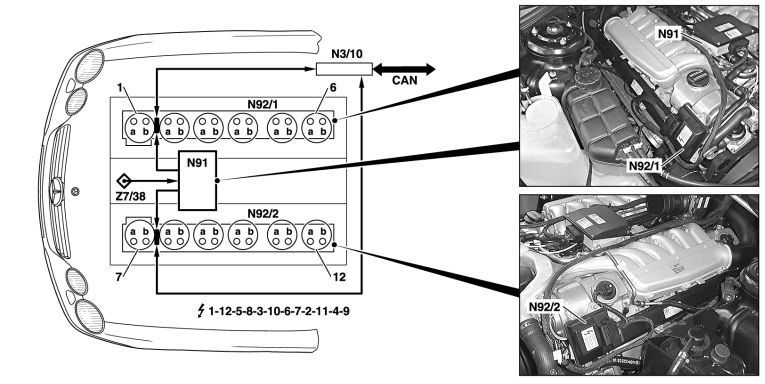
You are able to notice that before cylinder 12 is ignited, cylinder 1 should be ignited, before cylinder 10 is ignited, cylinder 3 should be ignited and before cylinder 11 is ignited, cylinder 2 should be ignited.
This seems a little to coincidental for me, so I'd say that there is a great chance that cylinders 1 to 3 ignite so late, that it is in the ignition window of cylinders 10 to 12, causing the ECU to pick up the acceleration of cylinders 1 to 3 as a misfire for 10 to 12.
I do hear knocking when the engine is cold and only when the engine is cold, cylinders 1 to 3, or 10 to 12 if you will, misbehave.
Ignition advance isn't that stable, it fluctuates greatly at hot idle, ranging from -8 deg to -6 deg. When cold it sits around -15 deg.
The fuel trim varies greatly at this point, ranging from -22% or even -33% to -6%. I've got no clue what is going on, but I read that when the SAI system is not working properly, the ECU reduces the fuel going into the engine in order to compensate for the 'rich' mixture. I've disabled SAI diagnosis because they where codes and I thought that this caused cylinders to be shut down. I'll re-enable it today and see what we get.
I'll check the plugs this weekend to see what they look like.
Have I updated you on the fuel rail pressure yet? It was around 2 bars, causing the engine to have troubles to stay running upon cold starts (cause more fuel is used when cold starting). Replaced the fuel pump and filter and the car runs much better.
I'll also take a look at repairing the coil pack as it seems to have aged a little.
Now you can write your own work order:
> Crazy Ignition Timing:
The spark timing advance is a calculated value, it's obviously far out of Max spec of -15°.
A normal working advance is near -5° to -8°.
Something in the ECU logic might need a reset after the ignition work you did to start fresh from a good base value.
IgnitionTiming is based on CKP sensor but that signal is well scrutinized for integrity.
>CKP Jitter -> Misfiring data:
Now it makes sense you are getting severe misfirings when ECU is trying to calculate a good timing advance.
Graph all the different MISFIRING PIDS available to see if that information helps point to your non-contributing cylinders. It may be un-true data because ECU is borderline out of the "closed loop" trying to point CKP jitter.
When the CKP expected signal shifts around early/late then ECU tries to pinpoint one particular cylinder as "misfiring" causing CKP jitter.
ECU adjust the mixture and the timing to produce consistent O2 exhaust results. This uses a dynamic map of previous datapoints, that's what you need to reset!
> Crazy Ignition Timing:
The spark timing advance is a calculated value, it's obviously far out of Max spec of -15°.
A normal working advance is near -5° to -8°.
Something in the ECU logic might need a reset after the ignition work you did to start fresh from a good base value.
IgnitionTiming is based on CKP sensor but that signal is well scrutinized for integrity.
>CKP Jitter -> Misfiring data:
Now it makes sense you are getting severe misfirings when ECU is trying to calculate a good timing advance.
Graph all the different MISFIRING PIDS available to see if that information helps point to your non-contributing cylinders. It may be un-true data because ECU is borderline out of the "closed loop" trying to point CKP jitter.
When the CKP expected signal shifts around early/late then ECU tries to pinpoint one particular cylinder as "misfiring" causing CKP jitter.
ECU adjust the mixture and the timing to produce consistent O2 exhaust results. This uses a dynamic map of previous datapoints, that's what you need to reset!
When comparing the ion current data for both banks (keep in mind that bank 2 has the new coil pack), I notice that cylinders 1 to 3 and 6 are rather low.
If we take a look at the firing order of this mighty V12
You are able to notice that before cylinder 12 is ignited, cylinder 1 should be ignited, before cylinder 10 is ignited, cylinder 3 should be ignited and before cylinder 11 is ignited, cylinder 2 should be ignited.
This seems a little to coincidental for me, so I'd say that there is a great chance that cylinders 1 to 3 ignite so late, that it is in the ignition window of cylinders 10 to 12, causing the ECU to pick up the acceleration of cylinders 1 to 3 as a misfire for 10 to 12.
I do hear knocking when the engine is cold and only when the engine is cold, cylinders 1 to 3, or 10 to 12 if you will, misbehave.
>Misfiring causes:
A while back, I said misfirings are not only caused by bad ignition plugs or coils. It's also caused by lean mixtures and wrong timing that cause unreliable firings regardless of strong sparks.
> Catch-22 here:
Bad firings cause rich O2 output, causes lean mixture, causes bad firings!!
So you see the vicious cycle once bad firing gets involved, right?
The ECU injection software is the very best mojo of BOSCH PhD engineers. It is some of the smartest real-time software that can be designed. In other words, you can trust the ECU logic is working all its "best efforts" to ignite your cylinders properly.
> CAN VIPs > timing latencies:
We've seen how the ECU job is to computes the best mixture/timing combination for all engine situations (Old/new, Cold/hot, Idling/uphill, ...).
That takes a bunch of sensors data, Bosch software and some CPU processing power to run all the compiled code.
Now let me shade the light on something uncommon. Realize that when VIP peripheral modules (F-SAM, TCU, CAN-C,...) that are in relation with ECU are loaded with DTC's, the engine precise timings are affected. That introduces fuziness in precise timings and additional random misfirings.
This is not the top cause of misfires but a super interesting knowledge to have in mind. You can not get the best engine driveability performance without humming CAN VIP's... DTC's introduce timing jitter that affects power output by 5 to 20%.
> Architecture is jitter sensitive:
The nuget is you want to reduce all factors that can affect precise timings. DTC's possible in CAN peripherals. Everything CAN is actually daisy chain like dominos after all. Try not to ignore "insignificant" faults connected to the ECU logic. This quirk took me over 20Yrs to figure out.

A while back, I said misfirings are not only caused by bad ignition plugs or coils. It's also caused by lean mixtures and wrong timing that cause unreliable firings regardless of strong sparks.
> Catch-22 here:
Bad firings cause rich O2 output, causes lean mixture, causes bad firings!!
So you see the vicious cycle once bad firing gets involved, right?
The ECU injection software is the very best mojo of BOSCH PhD engineers. It is some of the smartest real-time software that can be designed. In other words, you can trust the ECU logic is working all its "best efforts" to ignite your cylinders properly.
> CAN VIPs > timing latencies:
We've seen how the ECU job is to computes the best mixture/timing combination for all engine situations (Old/new, Cold/hot, Idling/uphill, ...).
That takes a bunch of sensors data, Bosch software and some CPU processing power to run all the compiled code.
Now let me shade the light on something uncommon. Realize that when VIP peripheral modules (F-SAM, TCU, CAN-C,...) that are in relation with ECU are loaded with DTC's, the engine precise timings are affected. That introduces fuziness in precise timings and additional random misfirings.
This is not the top cause of misfires but a super interesting knowledge to have in mind. You can not get the best engine driveability performance without humming CAN VIP's... DTC's introduce timing jitter that affects power output by 5 to 20%.
> Architecture is jitter sensitive:
The nuget is you want to reduce all factors that can affect precise timings. DTC's possible in CAN peripherals. Everything CAN is actually daisy chain like dominos after all. Try not to ignore "insignificant" faults connected to the ECU logic. This quirk took me over 20Yrs to figure out.
The fuel trim varies greatly at this point, ranging from -22% or even -33% to -6%. I've got no clue what is going on, but I read that when the SAI system is not working properly, the ECU reduces the fuel going into the engine in order to compensate for the 'rich' mixture. I've disabled SAI diagnosis because they where codes and I thought that this caused cylinders to be shut down. I'll re-enable it today and see what we get.
I'll check the plugs this weekend to see what they look like.
Have I updated you on the fuel rail pressure yet? It was around 2 bars, causing the engine to have troubles to stay running upon cold starts (cause more fuel is used when cold starting). Replaced the fuel pump and filter and the car runs much better.
I'll also take a look at repairing the coil pack as it seems to have aged a little.
Out Of Control!!
Joined: Apr 2019
Posts: 11,921
Likes: 6,773
From: Silicon Valley
W212 MY'14 M276-3.5NA @75kMi
progress & planning...
That's is fantastic Tim 
I am glad you're able to make progress. You still have ways to go!
After replacing your fuel pump, you need to reset the ECU to relearn more appropriate idle mixtutes without any pre-existing bias.
Your fuel trims way out range at -22 are cause for prime concern.
Get a good ignition to prevent misfiring and leaning to save your cats from unburnt raw fuel melt.

I am glad you're able to make progress. You still have ways to go!
After replacing your fuel pump, you need to reset the ECU to relearn more appropriate idle mixtutes without any pre-existing bias.
Your fuel trims way out range at -22 are cause for prime concern.
Get a good ignition to prevent misfiring and leaning to save your cats from unburnt raw fuel melt.
Out Of Control!!
Joined: Apr 2019
Posts: 11,921
Likes: 6,773
From: Silicon Valley
W212 MY'14 M276-3.5NA @75kMi
poor IGNITION causing lean trims
The deeply negative fuel trims (-22) are the result of ECU taking gas out of the mixture because the O2 sensor have measured your combustion being too rich.
Ignition misfire is likely your top problem here. When raw fuel comes out in the exhaust, O2 gets showered with gas then ECU leans out injection ratio. (We simplify the fact that long term trims are used to create a custom fuel map and short one are used for instant correcion). Acceptable trims are near zero +/- 5 points.
I know even that is not simple with the whole collection of dual spark plugs and upstream O2 sensors.
To help you zero-in on your offending cylinders:
Your engine really needs dependable spark before anything else here.

Ignition misfire is likely your top problem here. When raw fuel comes out in the exhaust, O2 gets showered with gas then ECU leans out injection ratio. (We simplify the fact that long term trims are used to create a custom fuel map and short one are used for instant correcion). Acceptable trims are near zero +/- 5 points.
I know even that is not simple with the whole collection of dual spark plugs and upstream O2 sensors.
To help you zero-in on your offending cylinders:
- Ensure you have good spark
- Upstream O2 towards 0 balance
Your engine really needs dependable spark before anything else here.
Last edited by CaliBenzDriver; Sep 1, 2022 at 12:37 PM.
Super Member
Joined: May 2021
Posts: 554
Likes: 150
From: Netherlands
CL 600 '00 5.8L V12
I'm starting to wonder if there is actually anything related to the combustion.
All kinds of different DTC's pop up

Heating of O2 sensors was never a problem, never seen the idle speed control implausible, I've replaced the right hall sensor.
The cylinder shutoff errors are right though, I've unplugged them xD
All kinds of different DTC's pop up
Heating of O2 sensors was never a problem, never seen the idle speed control implausible, I've replaced the right hall sensor.
The cylinder shutoff errors are right though, I've unplugged them xD
Out Of Control!!
Joined: Apr 2019
Posts: 11,921
Likes: 6,773
From: Silicon Valley
W212 MY'14 M276-3.5NA @75kMi
electrical fault...
beware half of these faults are not current! Yes they ate significant as power glitches.
It seems you have a poor electrical connection feeding +12V to your O2 (let's not say ECU has poor GND). So check the feed path is healthy and not too many oxidized contacts and relays.
If that does not deliver joy... then next figure what is feeding all the circuits flagged by those DTC'S. This will give you a ballpark to search in.
It seems you have a poor electrical connection feeding +12V to your O2 (let's not say ECU has poor GND). So check the feed path is healthy and not too many oxidized contacts and relays.
If that does not deliver joy... then next figure what is feeding all the circuits flagged by those DTC'S. This will give you a ballpark to search in.
Super Member
Joined: May 2021
Posts: 554
Likes: 150
From: Netherlands
CL 600 '00 5.8L V12
I've cleaned all the relays and fuses's contacts. They where quite coroded
I cleaned bank 1's sparkplugs and boi they where dirty.
I've also changed the ECU to be a EUR4/DTR. As soon as I did that, the secondary air injection started to work again.
Now, the engine ran with only 3 misfire counts and only on cylinder 6 (which has still got the worse looking sparkplugs).
Which is quite an improvement! The long term fuel trims where good, but only when I started to idle for quite a period after I've driven (and thus the self adaptation has adapted things),
the STFT went to -13%, which is what the LTFT will take over once a while.
In addition to that, I got a SAI left bank fault code. So the ECU still thinks the SAI system is not completely up and running again.
Does you know why the TWC Heating (or raising the engine speed to 1400 rpms upon cold start, to heat the TWCs) might not work on cold starts?
I didn't fully heat up the car, so the engine was not that smooth, but the misfires are almost gone
I cleaned bank 1's sparkplugs and boi they where dirty.
I've also changed the ECU to be a EUR4/DTR. As soon as I did that, the secondary air injection started to work again.
Now, the engine ran with only 3 misfire counts and only on cylinder 6 (which has still got the worse looking sparkplugs).
Which is quite an improvement! The long term fuel trims where good, but only when I started to idle for quite a period after I've driven (and thus the self adaptation has adapted things),
the STFT went to -13%, which is what the LTFT will take over once a while.
In addition to that, I got a SAI left bank fault code. So the ECU still thinks the SAI system is not completely up and running again.
Does you know why the TWC Heating (or raising the engine speed to 1400 rpms upon cold start, to heat the TWCs) might not work on cold starts?
I didn't fully heat up the car, so the engine was not that smooth, but the misfires are almost gone
Out Of Control!!
Joined: Apr 2019
Posts: 11,921
Likes: 6,773
From: Silicon Valley
W212 MY'14 M276-3.5NA @75kMi
no 1400rpm warm up
I've cleaned all the relays and fuses's contacts. They where quite coroded
I cleaned bank 1's sparkplugs and boi they where dirty.
I've also changed the ECU to be a EUR4/DTR. As soon as I did that, the secondary air injection started to work again.
Now, the engine ran with only 3 misfire counts and only on cylinder 6 (which has still got the worse looking sparkplugs).
Which is quite an improvement! The long term fuel trims where good, but only when I started to idle for quite a period after I've driven (and thus the self adaptation has adapted things),
the STFT went to -13%, which is what the LTFT will take over once a while.
In addition to that, I got a SAI left bank fault code. So the ECU still thinks the SAI system is not completely up and running again.
Does you know why the TWC Heating (or raising the engine speed to 1400 rpms upon cold start, to heat the TWCs) might not work on cold starts?
I didn't fully heat up the car, so the engine was not that smooth, but the misfires are almost gone
I cleaned bank 1's sparkplugs and boi they where dirty.
I've also changed the ECU to be a EUR4/DTR. As soon as I did that, the secondary air injection started to work again.
Now, the engine ran with only 3 misfire counts and only on cylinder 6 (which has still got the worse looking sparkplugs).
Which is quite an improvement! The long term fuel trims where good, but only when I started to idle for quite a period after I've driven (and thus the self adaptation has adapted things),
the STFT went to -13%, which is what the LTFT will take over once a while.
In addition to that, I got a SAI left bank fault code. So the ECU still thinks the SAI system is not completely up and running again.
Does you know why the TWC Heating (or raising the engine speed to 1400 rpms upon cold start, to heat the TWCs) might not work on cold starts?
I didn't fully heat up the car, so the engine was not that smooth, but the misfires are almost gone
The ECU is having a hard time controlling the RPM.
Are the intake temp and coolant temp read nearly accurate values cold and warmed up?
Super Member
Joined: May 2021
Posts: 554
Likes: 150
From: Netherlands
CL 600 '00 5.8L V12
On the way to work today, I noticed that the engine run a little cooler (after driving the usual distance), started smoother (not as smooth as you'd expect) and run better when cold.
I did notice that the fuel trims went negative again, but only if I was not on the power. Whenever I gave it some gas, the fuel trims went up again.
It looks like this relates to the roughness that I get during idle and during constant speed driving.
By the way, the engine definitely makes a huge amount of extra power.
I'd say they are, around 83 degrees celcius with full ram cold air (17 deg outside) and 95 when driving in urban areas. The intake temp slowly rises to around 50 degrees c.
Out Of Control!!
Joined: Apr 2019
Posts: 11,921
Likes: 6,773
From: Silicon Valley
W212 MY'14 M276-3.5NA @75kMi
That would make sense!
...
I did notice that the fuel trims went negative again, but only if I was not on the power.
Whenever I gave it some gas, the fuel trims went up again.
It looks like this relates to the roughness that I get during idle and during constant speed driving.
By the way, the engine definitely makes a huge amount of extra power.
...
.
...
I did notice that the fuel trims went negative again, but only if I was not on the power.
Whenever I gave it some gas, the fuel trims went up again.
It looks like this relates to the roughness that I get during idle and during constant speed driving.
By the way, the engine definitely makes a huge amount of extra power.
...
.
These are encouraging results you're after doing the right things.
You don't need to WOT to feel power! Quite the opposite: when the engine combustion is well balanced, the engine is responsive and you get smooth linear power. It's gentle, powerful and nice to drive around.
Good job Tim, your efforts, patience and research are adding up.
Super Member
Joined: May 2021
Posts: 554
Likes: 150
From: Netherlands
CL 600 '00 5.8L V12
Any ideas how I could track down any rough idle? People on the interwebs state that the Idle Air Control valve should be checked, but I don't have such an valve.
I read somewhere that it could be the throttle bodies position sensor, but that seems to work fine
I read somewhere that it could be the throttle bodies position sensor, but that seems to work fine
Out Of Control!!
Joined: Apr 2019
Posts: 11,921
Likes: 6,773
From: Silicon Valley
W212 MY'14 M276-3.5NA @75kMi
bad mixture....
Tim I don't think you can call your problem "rough idle"... It would be a "rough idle" if mixture was bad only at idle.
Rough idle is the result of poor combustion in absence of misfires events away from idle.
I think what is left of your rough combustion is regardless of engine RPM, right?
I am saying that to save your time. If you research "bad idle" the results won't help your problem.
You'll get smooth idle when the LTFT are +/- 4 or near that.
So it's back to mixture, spark, O2 and fuel trims.
What sort of timing chain setup do you have? When the chain tension is poor or loose, half the V-engine distribution timing is slightly off. You need smooth stable tension... beware these days the tensioners have been made consumable wear items. It's no longer a lifetime part.
Rough idle is the result of poor combustion in absence of misfires events away from idle.
I think what is left of your rough combustion is regardless of engine RPM, right?
I am saying that to save your time. If you research "bad idle" the results won't help your problem.
You'll get smooth idle when the LTFT are +/- 4 or near that.
So it's back to mixture, spark, O2 and fuel trims.
What sort of timing chain setup do you have? When the chain tension is poor or loose, half the V-engine distribution timing is slightly off. You need smooth stable tension... beware these days the tensioners have been made consumable wear items. It's no longer a lifetime part.
Last edited by CaliBenzDriver; Sep 5, 2022 at 12:42 PM.
Super Member
Joined: May 2021
Posts: 554
Likes: 150
From: Netherlands
CL 600 '00 5.8L V12
Please find a video of the chain tension here: (add a dot instead of the letters 137
https://photos.app.goo137gl/pLAQJYe2Umhu7hTs9
Are these tensioners plug and play, or do I need to take half of the engine apart?
The chain is an continuous chain that runs over both banks. The car has 210k km so replacing them wouldn't hurt I think.
I still find it curious why on one drive the fuel trims are good and on the other they go down to -22%
https://photos.app.goo137gl/pLAQJYe2Umhu7hTs9
Are these tensioners plug and play, or do I need to take half of the engine apart?
The chain is an continuous chain that runs over both banks. The car has 210k km so replacing them wouldn't hurt I think.
I still find it curious why on one drive the fuel trims are good and on the other they go down to -22%
Last edited by tim687; Sep 5, 2022 at 03:21 PM.
Out Of Control!!
Joined: Apr 2019
Posts: 11,921
Likes: 6,773
From: Silicon Valley
W212 MY'14 M276-3.5NA @75kMi
oh yeah!
Please find a video of the chain tension here: (add a dot instead of the letters 137
https://photos.app.goo137gl/pLAQJYe2Umhu7hTs9
Are these tensioners plug and play, or do I need to take half of the engine apart?
The chain is an continuous chain that runs over both banks. The car has 210k km so replacing them wouldn't hurt I think.
I still find it curious why on one drive the fuel trims are good and on the other they go down to -22%
https://photos.app.goo137gl/pLAQJYe2Umhu7hTs9
Are these tensioners plug and play, or do I need to take half of the engine apart?
The chain is an continuous chain that runs over both banks. The car has 210k km so replacing them wouldn't hurt I think.
I still find it curious why on one drive the fuel trims are good and on the other they go down to -22%
@ 200,000Km.... 90% chance your timing chain tensioner is sloppy loose.
Wobbly camshafts will screw with stable engine timing and yield misfires and reduced power. Definitely a top item on the list!
The easy tell-tale sign is the idle SOUND:
BAD : vroom-vroom-vroom: jerky idle
GOOD : vroooooooooooom: smooth idle
I would NOT go over board with chain + guides, only do the quick tensioner.
FUEL TRIMS:
Disregard Fuel Trims numbers while driving! The ECU is enriching/leaning mixture based on accelerator demand.
The LTFT is only meaningful at stable warmed up idle.
Last edited by CaliBenzDriver; Sep 5, 2022 at 03:58 PM.
Super Member
Joined: May 2021
Posts: 554
Likes: 150
From: Netherlands
CL 600 '00 5.8L V12
Thanks Cali! You are really helping me out here!
Particularly when cold, the engine goes like vroom-vroom-vroom. When hot the engine purs like a kitten, but has a slight flucuation in rpms now and then. I assume that hot engines are more tolerant, since the mixture ignites more easily.
Are there any other of such items that need to be replaced after 200k?
Where you able to watch my video?
Also, yesterday evening I've set the enrichment correction to enrich (not slightly enrich, if I recall correctly) and low en behold
THE ECU DID IT'S WARM UP THING THIS MORNING
Also the drive was noticeably smoother and better.
Particularly when cold, the engine goes like vroom-vroom-vroom. When hot the engine purs like a kitten, but has a slight flucuation in rpms now and then. I assume that hot engines are more tolerant, since the mixture ignites more easily.
Are there any other of such items that need to be replaced after 200k?
Where you able to watch my video?
Also, yesterday evening I've set the enrichment correction to enrich (not slightly enrich, if I recall correctly) and low en behold
THE ECU DID IT'S WARM UP THING THIS MORNING
Also the drive was noticeably smoother and better.
Super Member
Joined: May 2021
Posts: 554
Likes: 150
From: Netherlands
CL 600 '00 5.8L V12
Somebody on the other forum states that it could still very well be that the oil cooler inside the valley of the V is leaking on the PCV system side, thus creating an vacuum leak.
I'll try to do another smoke test this weekend to confirm this issue (hopefully not)
I'll try to do another smoke test this weekend to confirm this issue (hopefully not)


