




TTM Fuel Rail / Injectors ---> OE Tuned!

Thread Starter
MBWorld Fanatic!
Joined: Mar 2010
Posts: 1,909
Likes: 4
From: San Diego
F-250
 TTM Fuel Rail / Injectors ---> OE Tuned!
There has been a lot of positive talk about the TTM Fuel Rail - Injector Kit, and in one case, it even brought together parties who previously had not seen eye to eye.
As of the last post from Bruce at TTM, "There is only one tuner with experience tuning this rail and injectors".. not any more....
We installed the new TTM fuel rail yesterday at OE Tuning in Van Nuys CA, and Jeremy went to work tuning. Process took a few hours to find the sweet spot, but when the dyno dust settled...
Not only did I make more power throughout (+25HP to +30HP), Jeremy was able to extend the powerband out to redline, (+56HP @ 6100). We compared a lot of OE Tuned E55 graphs, and they ALL fall off around 5600. Now, we are able to carry peak HP all the way to the limiter.
Bruce claims 25 HP with the rail, however what he forgot to mention is that the added HP carries forever, and realistically, the gains surpass what a chart shows. Drivability is better than stock. Smooth Idle, immediate power... But it PULLLLLLLLLLLLLLLs now...
Jeremy did an awesome job tuning this, and I know there will be more to come from OE Tuning once all you f^*%$ get the idea to do this.
Although it was over 100 degrees, Jeremy was able to wiggle 492 HP out of the car on 91 pump gas.
Big Thanks to both Bruce at TTM and Jeremy at OE Tuning for making this happen!!

As of the last post from Bruce at TTM, "There is only one tuner with experience tuning this rail and injectors".. not any more....
We installed the new TTM fuel rail yesterday at OE Tuning in Van Nuys CA, and Jeremy went to work tuning. Process took a few hours to find the sweet spot, but when the dyno dust settled...
Not only did I make more power throughout (+25HP to +30HP), Jeremy was able to extend the powerband out to redline, (+56HP @ 6100). We compared a lot of OE Tuned E55 graphs, and they ALL fall off around 5600. Now, we are able to carry peak HP all the way to the limiter.
Bruce claims 25 HP with the rail, however what he forgot to mention is that the added HP carries forever, and realistically, the gains surpass what a chart shows. Drivability is better than stock. Smooth Idle, immediate power... But it PULLLLLLLLLLLLLLLs now...
Jeremy did an awesome job tuning this, and I know there will be more to come from OE Tuning once all you f^*%$ get the idea to do this.
Although it was over 100 degrees, Jeremy was able to wiggle 492 HP out of the car on 91 pump gas.
Big Thanks to both Bruce at TTM and Jeremy at OE Tuning for making this happen!!
Last edited by Bramage; Jul 3, 2011 at 09:34 AM.

MBWorld Fanatic!
Joined: Jun 2010
Posts: 4,173
Likes: 7
From: Puerto Rico
2005 E55 AMG
Hmm..I still think the tune it's self has more to do with the power gains than the rail/injectors. The rail/injectors are important no doubt, and I want them soon, but I don't see power falling in my curve.
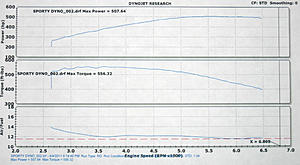
From 5000 to 6400 power stays flat and only in the last 100rpm does it dip ( probably from reaching the revlimiter ).
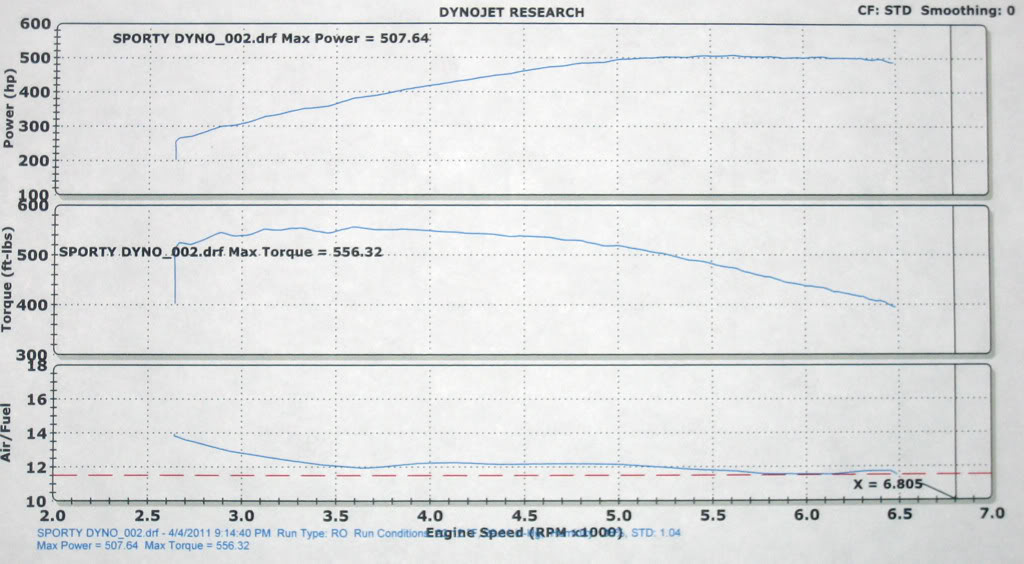
From 5000 to 6400 power stays flat and only in the last 100rpm does it dip ( probably from reaching the revlimiter ).
Thread Starter
MBWorld Fanatic!
Joined: Mar 2010
Posts: 1,909
Likes: 4
From: San Diego
F-250
GT-R, you have a nice flat top end, but your peak is at 5600. Granted, you dont drop off like most do. My peak was at 6400. The track will tell the rest of the story. I did not even discuss th benifits of not burning a hole through #8...
MBWorld Fanatic!
Joined: Jun 2010
Posts: 4,173
Likes: 7
From: Puerto Rico
2005 E55 AMG
Again, I'm not knocking the fueling system since I do see it's advantages.

Thread Starter
MBWorld Fanatic!
Joined: Mar 2010
Posts: 1,909
Likes: 4
From: San Diego
F-250
I will put this on a dyno jet when I get back to San Diego. I am very curious what that dyno (and decent temps) will provide. The point of this thread: We have a starvation issue once we mod to a certain point. #8 can and will burn up, it is well documented. This mod should help prevent that, and the added HP and TRQ is just a nice byproduct. Bruce can provide those details, I just drive.. 
Trending Topics

Super Member
Joined: Dec 2009
Posts: 848
Likes: 6
From: New Cumberland, PA
ML63
Nice going and thanks for posting up your thoughts and FACTS.
Other new people to the forum seem to go off what they know from other cars not MB's.
Every car has it's weak points.
Any good engine builder or tech will tell you every monster build has it's demons and #8 is ours lets hope this keeps it in the closet.
Other new people to the forum seem to go off what they know from other cars not MB's.
Every car has it's weak points.
Any good engine builder or tech will tell you every monster build has it's demons and #8 is ours lets hope this keeps it in the closet.
MB World Stories
The Best of Mercedes & AMG

Manual Mercedes? 6 Times Sindelfingen Let Drivers Have All The Fun
Verdad Gallardo
Mercedes SLR McLaren 722 S Is Extremely Rare Example Modified by McLaren
Verdad Gallardo
8 Classic Boxy Mercedes Designs That Have Aged Like Fine Wine
Verdad Gallardo
Flawlessly Restored Mercedes 190E Evo II Heads to Auction
Verdad Gallardo
Electric Mercedes C-Class Unveiled: 11 Things You Need to Know
Verdad Gallardo
Mercedes EQS Gets A Major Update: Everything You Need to Know
Verdad Gallardo
5 Underrated Mercedes-Benz Models That Don't Get the Love They Deserve
Verdad Gallardo
Mercedes 300D Has Pushed Well Past 1 Million Miles and It Ain't Stopping
Verdad Gallardo
10 Most Reliable Mercedes-Benz Models You Can Buy Used
Verdad Gallardo
MBWorld Fanatic!
Joined: Oct 2006
Posts: 1,603
Likes: 0
From: merryland
cornfed gtr and m3
Nice going and thanks for posting up your thoughts and FACTS.
Other new people to the forum seem to go off what they know from other cars not MB's.
Every car has it's weak points.
Any good engine builder or tech will tell you every monster build has it's demons and #8 is ours lets hope this keeps it in the closet.
Other new people to the forum seem to go off what they know from other cars not MB's.
Every car has it's weak points.
Any good engine builder or tech will tell you every monster build has it's demons and #8 is ours lets hope this keeps it in the closet.
I don't think it can be overstated how important this mod is in the preservation of a properly modded 55k motor. The fact that there are whp gains on the upper end with it is just icing on the cake. Great job to Jeremy , Bruce and to Dane for putting his car out there.


MBWorld Fanatic!
Joined: Aug 2007
Posts: 2,596
Likes: 5
From: Jacksonville, FL
05 White Pano E55, Cadillac CTS-V
In my opinion the rail accomplishes next to nothing for any kind of performance increase, that is all about running bigger injectors which can handle the flow and be controlled at higher hp. I am sure some will disagree but that is fine.

MBWorld Fanatic!
Joined: Dec 2005
Posts: 1,653
Likes: 5
From: Ann Arbor
'03 SL55
The TTM fuel rail is a closed loop which equalizes the pressure across the injectors. The factory fuel rail has a pressure drop from the first to the last injector on each line. At some level of tuning the pressure drop in the factory fuel rail will become a performance bottleneck.
For what it's worth....

MBWorld Fanatic!


Joined: Jan 2005
Posts: 4,276
Likes: 28
From: Bay Area
2015 E63S, 2018 E63S
The performance (hp wise) was never the goal of the rail. The goal was to solve our #8 issue and in the process additional HP was discovered over the stock setup. I would say the combination of both adding to the performance increase.
MBWorld Fanatic!
Joined: Aug 2007
Posts: 2,596
Likes: 5
From: Jacksonville, FL
05 White Pano E55, Cadillac CTS-V
I will say show me a before/after with only the rail before you can say the rail is causing the change. Like I said, it is the bigger injectors that have controllability and aren't running 100% duty cycle ie (staying wide open) which will cause more of a stable pressure and the correct amount of fuel being injected which will cause the increase. If the fuel pumps can flow enough to sustain pressure at higher power levels, than the smaller stock injectors are the problem of pressure drop once the point is reached when they remain static and don't close (think a garden hose with the nozzle off the end instead of slightly opened like a bigger injector would be).
There is no difference in the way the fuel is delivered to the rail (from the back) from many other cars so saying it is because it builds pressure from the front is irrelevant if you ask me. Think about it for a second, having the rail looped just causes the fuel to come in the back like normal and then build pressure back once the fuel meets each other on the two front sides where it is looped instead of hitting the end of each rail and then working back. It is doing the same thing, you guys are thinking to much in to this.
There is no difference in the way the fuel is delivered to the rail (from the back) from many other cars so saying it is because it builds pressure from the front is irrelevant if you ask me. Think about it for a second, having the rail looped just causes the fuel to come in the back like normal and then build pressure back once the fuel meets each other on the two front sides where it is looped instead of hitting the end of each rail and then working back. It is doing the same thing, you guys are thinking to much in to this.
Thread Starter
MBWorld Fanatic!
Joined: Mar 2010
Posts: 1,909
Likes: 4
From: San Diego
F-250
Hawkins..
We held at 11.0 AFR at top end. Tip in held the same pattern as all other final tunes I have done with Jeremy, and we left the other .5 on the table due to the temps (+100).
The car feels 500 LB lighter now... Effortless power
We held at 11.0 AFR at top end. Tip in held the same pattern as all other final tunes I have done with Jeremy, and we left the other .5 on the table due to the temps (+100).
The car feels 500 LB lighter now... Effortless power
MBWorld Fanatic!
Joined: Jun 2010
Posts: 4,173
Likes: 7
From: Puerto Rico
2005 E55 AMG
Jerry tuned my car...it was a canned tune ( not dyno tuned ).
I DO see the point of the rail. Mt previous car beforethe E55 was an Infiniti G35 and when I went with an aftermaket fuel rail the pressure would hold much more steady and any fluctuations would be smoother. Once I went with a fuel return system, the fuel pressure was pretty much rock solid.
While a fuel return would mostly be useless on the E55, I can see the benefits of the rail. It's all theory though, so I would definitely love to see the proof urbamworm is looking for.
I DO see the point of the rail. Mt previous car beforethe E55 was an Infiniti G35 and when I went with an aftermaket fuel rail the pressure would hold much more steady and any fluctuations would be smoother. Once I went with a fuel return system, the fuel pressure was pretty much rock solid.
While a fuel return would mostly be useless on the E55, I can see the benefits of the rail. It's all theory though, so I would definitely love to see the proof urbamworm is looking for.
MBWorld Fanatic!
Joined: Dec 2005
Posts: 1,653
Likes: 5
From: Ann Arbor
'03 SL55
I will say show me a before/after with only the rail before you can say the rail is causing the change. Like I said, it is the bigger injectors that have controllability and aren't running 100% duty cycle ie (staying wide open) which will cause more of a stable pressure and the correct amount of fuel being injected which will cause the increase. If the fuel pumps can flow enough to sustain pressure at higher power levels, than the smaller stock injectors are the problem of pressure drop once the point is reached when they remain static and don't close (think a garden hose with the nozzle off the end instead of slightly opened like a bigger injector would be).
There is no difference in the way the fuel is delivered to the rail (from the back) from many other cars so saying it is because it builds pressure from the front is irrelevant if you ask me. Think about it for a second, having the rail looped just causes the fuel to come in the back like normal and then build pressure back once the fuel meets each other on the two front sides where it is looped instead of hitting the end of each rail and then working back. It is doing the same thing, you guys are thinking to much in to this.
A fuel rail is shorter than a irrigation pipe so there's less of a pressure drop but engine builders still have to account for the pressure drop in their engine design. For the 55K engines Mercedes determined that the end-supplied, straight fuel rails were sufficient. However for the SLR engine Mercedes used a loop fuel rail rather than the straight rails from the 55K engine.
Ferrari uses loop fuel rails too, at least on some of their engines.
Don't just take my word for it. Read around a bit and you'll find lots of sources that confirm what I've summarized above.
Thread Starter
MBWorld Fanatic!
Joined: Mar 2010
Posts: 1,909
Likes: 4
From: San Diego
F-250
Hawkins..
I inspected the mixture graphs on the dyno, and we also logged short term and long term fuel trim levels through the zietronix.
Also pulled some comparative numbers between the zeitronix and the dyno. Once the injectors were scaled, and we had our stock maps happy at idle, we were running very rich up top 9.X.
Jeremy is very methodical, and does not make large changes. Through the next 4 pulls, we brought this up. The tune is very conservative if you ask me, but I am not a tuner. We flat line around 11.0 where we are making 185 - 192 HP. Tip in is very typical to all other pulls I have made on the Gintani / OE Dyno.
Urbam
The gains are from the fuel rail and injectors. There might be a little in the rail by preventing starvation, however the two together produce the claimed HP.
If you count HP and Torque gains at the very top end, I picked up +50 of each. Through the range, I picked up between 25-30 HP as the dyno shows.
The comparative dyno numbers are from my last tune, done in September. The only change between the two dyno graphs is the date, and the rail/injectors.
If you are looking for proof that this modification adds power, look no further than post #1.
Bruce will have to chime in the the how/why, but here is how I understand it:
Dual Spray Pattern directing fuel directly into intake runners adds a lot of fuel efficiency, which means you can get more power with the same amount of gas. Without atomization, the fuel does not burn efficiently, or produce power efficiently. Bruce?
PS- Jerry did a write up as well, and confirmed gains, so this is supported data.
I inspected the mixture graphs on the dyno, and we also logged short term and long term fuel trim levels through the zietronix.
Also pulled some comparative numbers between the zeitronix and the dyno. Once the injectors were scaled, and we had our stock maps happy at idle, we were running very rich up top 9.X.
Jeremy is very methodical, and does not make large changes. Through the next 4 pulls, we brought this up. The tune is very conservative if you ask me, but I am not a tuner. We flat line around 11.0 where we are making 185 - 192 HP. Tip in is very typical to all other pulls I have made on the Gintani / OE Dyno.
Urbam
The gains are from the fuel rail and injectors. There might be a little in the rail by preventing starvation, however the two together produce the claimed HP.
If you count HP and Torque gains at the very top end, I picked up +50 of each. Through the range, I picked up between 25-30 HP as the dyno shows.
The comparative dyno numbers are from my last tune, done in September. The only change between the two dyno graphs is the date, and the rail/injectors.
If you are looking for proof that this modification adds power, look no further than post #1.
Bruce will have to chime in the the how/why, but here is how I understand it:
Dual Spray Pattern directing fuel directly into intake runners adds a lot of fuel efficiency, which means you can get more power with the same amount of gas. Without atomization, the fuel does not burn efficiently, or produce power efficiently. Bruce?
PS- Jerry did a write up as well, and confirmed gains, so this is supported data.

MBWorld Fanatic!
Joined: Sep 2002
Posts: 1,719
Likes: 12
From: West
2005 E55 Wagon
Just to be clear, TTM claims that the performance improvement results from both the injectors and fuel rail, not the fuel rail standalone.
The thing is, there really is a pressure drop when fluid runs through conduit whether it's a fuel rail or a water pipe. Loops also really do equalize pressure, whether it's an irrigation system on a farm, a multi-head shower system, or the fuel rail on a high powered engine.
A fuel rail is shorter than a irrigation pipe so there's less of a pressure drop but engine builders still have to account for the pressure drop in their engine design. For the 55K engines Mercedes determined that the end-supplied, straight fuel rails were sufficient. However for the SLR engine Mercedes used a loop fuel rail rather than the straight rails from the 55K engine.
Ferrari uses loop fuel rails too, at least on some of their engines.
Don't just take my word for it. Read around a bit and you'll find lots of sources that confirm what I've summarized above.
The thing is, there really is a pressure drop when fluid runs through conduit whether it's a fuel rail or a water pipe. Loops also really do equalize pressure, whether it's an irrigation system on a farm, a multi-head shower system, or the fuel rail on a high powered engine.
A fuel rail is shorter than a irrigation pipe so there's less of a pressure drop but engine builders still have to account for the pressure drop in their engine design. For the 55K engines Mercedes determined that the end-supplied, straight fuel rails were sufficient. However for the SLR engine Mercedes used a loop fuel rail rather than the straight rails from the 55K engine.
Ferrari uses loop fuel rails too, at least on some of their engines.
Don't just take my word for it. Read around a bit and you'll find lots of sources that confirm what I've summarized above.
I agree. That is why I believe there are benefits from the looped fuel rail. People have thought alot about the fuel rail. A solution resulted. The solution is consistent with higher end engines and how fuel issues were addressed by other aftermarket vendors for other cars.
I also look at it another way. Show me proof that there are no benefits, bc there is proof (such as it being in other high end cars) that there are benefits.

MBWorld Fanatic!
Joined: Jan 2007
Posts: 2,597
Likes: 19
From: Kuwait
CLS55 2006, CLS 63S 2015
Bramage please tell Jeremy to get his *** tuning an LT car!
have you done normal driving around town logging and WOT logging to see that this file for the new injectors rail is up to snuf?
have you done normal driving around town logging and WOT logging to see that this file for the new injectors rail is up to snuf
?
MBWorld Fanatic!
Joined: Jan 2005
Posts: 4,276
Likes: 28
From: Bay Area
2015 E63S, 2018 E63S
Thread Starter
MBWorld Fanatic!
Joined: Mar 2010
Posts: 1,909
Likes: 4
From: San Diego
F-250

In terms of logging- Yes. I am logging all the time, and I am paying close attention with the new tune. It is spot on. As I mentioned, drivability is improved. Idle, cruising, responsivness all better. And when I get on it, it is a different car.


