When you click on links to various merchants on this site and make a purchase, this can result in this site earning a commission. Affiliate programs and affiliations include, but are not limited to, the eBay Partner Network.
Today I removed my coolant and managed to remove completely the dumb-azz radiator plug.
I then blow compressed air into the coolant recovery bottle to speed up coolant drain..........so I thought..........
Blo-ody hell, still there is so much LEFT-OVER sin commited in 2014 by MB Indonesia assembly plant !!!!
.
.
.
So I boroscope my radiator INPUT side.
Below is from the drain hole
.
.
.
.
.
.
Below is from the big radiator INPUT hose from thermostat. Sama side as above the INPUT side, but camera has better room to move and wiggle
.
.
.
.
.
.
WTF !!!!!!
The OUTPUT side is clean, the flat pipe holes are so small, I think 95% garbage is stuck at INPUT side.
I have to buy a new radiator
===============
MORE NASTY surprise.
I am doing turbo coolant hose-pipe refresh, the one with plastic tee, below :
.
.
.
.
.
.
.
It should be clean like below :
.
.
The turbo coolant port BOTTOM ONE
BOTTOM ONE
.
TOP ONE
.
TOP ONE
I am so pissed with the work ethic during local assembly of this car.
High calcium water or high TDS water and with very low coolant percentage 11 years ago in 2014, albeit corrected in 2018, the remaining damage still exist.
All I am worried for turbo is, when the female coolant port is no more smooth due to this corossion, the o-ring even when new as in new pipe too..........may leak.
It never been leaking coolant at turbo, because the rust stop the leak. With cleaned surface at female port steel, it may leak.
No room to work for cleaning !!!!!
I struggle removing the heat shields, 3 pcs
I have to wear glove and protection sleeve to prevent cuts, it is brutal in there rubbing my hand with car side heat shield and sharp objects.
.
Will update tomorrow..........
Last edited by S-Prihadi; Jun 17, 2025 at 12:45 PM.
Those look like huuuuuuuuuuuge pieces of calcium carbonate or whatever salt that would be... The chunks look like they're about 5-7mm? And they are such a pure white--not contaminated by any of the rusty orange **** in there...
Why can’t the radiator be removed, and tubes unplugged, and all other debris cleared? Is the concern that the radiator itself is the cause or catalyst for the calcium precipitation?
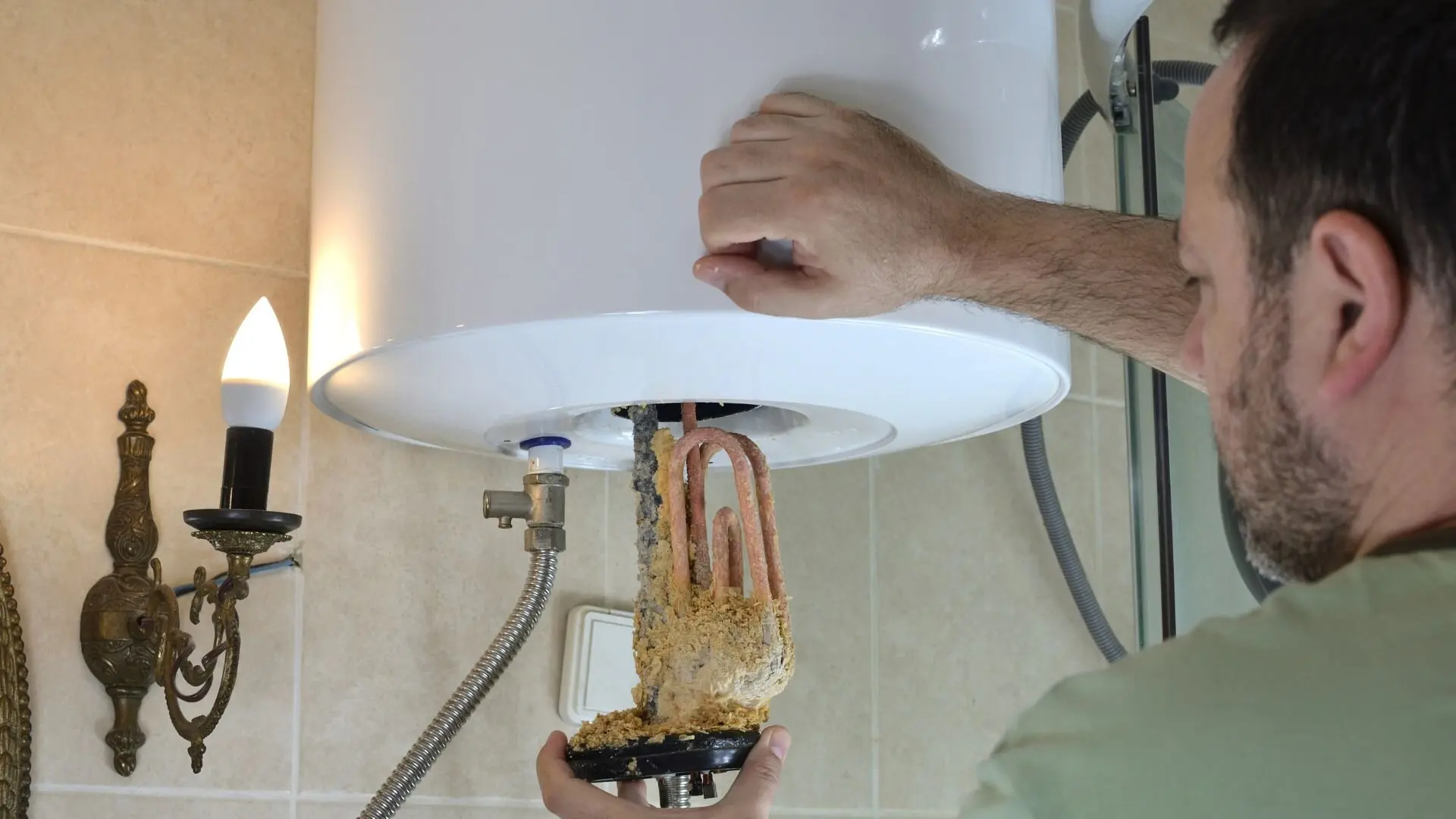
Well, when the water is deemed as "hard water" , which is common in Indonesia due to massive use of well water, at hot enough temperature those calcium will precipitate.
Simple example below : water heater the usual victim
Its obvious from the link I gave that MB Indonesia for unknown reason back in 2014 during assembly was using hard water and low coolant ( oldie yellow-gold one ) percentage. https://mbworld.org/forums/e-class-w...i-am-sure.html
In above link , in 2019 I had to replace my coolant pump and hoses, due to rust.
Calcium party
At that point in time, I replaced the coolant with the blue one and uses distilled water at 50/50 mix.
But I can't flush like I did in 2024 and only yesterday I was able to remove radiator drain valve ( because I got spare one already ).
So, all these years, the accumulation of the calcium + whatever else, the loose one.... could not be removed or be seen , because I dare not remove the radiator drain plug which is at the INPUT side.
I relied soley on INPUT and OUTPUT hose removal and the small opening on the radiator drain.
I will remove my radiator today, and flush it again while I order a new one.
I may choose Denso and it is actually made in Indonesia. MB genuine one will need 3-4 months special order, in most cases.
.
.
.
.
When I get this Denso version, the tranny cooler port I do not use. My car has stand alone tranny oil cooler.
My original one is Valeo and it has internal P/N which does not exist in EPC.
I noticed MB internal part number a few times already. I think it is for vendor to MB and not like EPC which is for user or dealer.
Denso has production plant in Indonesia, they are big......because Toyota owned Denso and Toyota is the biggest brand in Indonesia.
My HVAC Denso internal heat exchanger pipe is made in Indonesia.
This semi plugged radiator may explained why at the race track in 2020, ony 3 laps drive moderately hard driving, my coolant temp hit 120C already.
Street use never an issue.
-------------
This is the Valeo P/N and EPC has no data on it.
.
Mine is like below, no tranny oil ports.
This is what I mean by internal part number
Vendor to MB only I suppose.
=============
Something I want to share, it baffled me a great deal.
The dumb azz drain valve of my radiator.
How the hell it locked to the female side of the radiator baffled me.
No thread at the radiator side. Smooth bore.
.
.
Below from somebody's post, the radiator side has the thread to "accept" the drain plug.
My drain plug works well without the female radiator side thread
However, installing the drain valve/plug need some patience.
I would think the radiator is the least of his worries. Imaging that stuff in the engine block and heater core.
My HVAC heater core has been bypassed, no worry.
My engine oil cooler now I worry.........., it probably have the same small flat pipe like radiator.
I also worry of my cylinder head gasket........ for ex-corossion concern.
The radiator flat pipe is very small, about max 2-3mm opening only.
I use the usual pointy pick and the point pick main shaft is 2.5x wider that the flat pipe. The tip of the pointy pick can enter the flat pipe, but only so short a depth, after that too fat.
This kind of pointy pick
===============
I was just planning things out for my car all plastic and rubber refresh.,,,the 3 most difficult ones which I have not done.
Worst one is : I can't do the timing chain region crossover coolant o-ring, as it needs oil pan to come out too.
So engine out seems 99% and I rather get my Indie to do it, while I be there as BUSY BODY
I plan for 2028, but it seems now with yesterday unfolding event, I may speed it up to 2026.
For my own entertainment, I am doing below now : Hence I discovered the unfortunate Calcium Party running wild .....
I am keeping my HPFP, it is good and new since at least 36,000KM mileage. My orginal one is still good too.
I track their operational pressure, no worry.
Here : https://mbworld.org/forums/e-class-w...l-warning.html
My sway bar no issue, as tight as virgin. In fact I am surpised my two front suspension arms are still good, but I did replace the L ball joint after the track session back in 2020.
Last edited by S-Prihadi; Jun 18, 2025 at 01:03 AM.
I am probably not telling anyone here anything new, but only distilled water should ever be used in the cooling system. On balance a 50/50 mixture of ethylene glycol coolant and distilled water is the best all around concentration to use in climates where winter weather brings freezing temperatures, but in the tropics, where it’s unheard of to observe freezing temperatures at any season of the year, less coolant could be used.
The coolant to distilled water ratio is an interesting one. There are several variables to resolve by the perfect ratio.
Some of the variables are:
Fluid cooling properties of distilled water, which is much better than the coolant, versus the projected temperatures the coolant will be exposed to.
So, specific heat.
Boiling point elevation, and freezing point reduction, although in S-Prihadi’s environment, freezing point reduction is not a concern.
At sea level, distilled water boils at 212F(100C) and freezes at 32F(0C). Increasing coolant concentrations will elevate the boiling point, and reduce the freezing point.
Corrosive properties of fluids:
Water ionizes rather easily, and allows electrical current to pass through it, setting up dissimilar metals in the cooling systems to become anodes, or cathodes, then leeching metals from one type of metal and deposition onto another type of metal.
The coolant suppresses the ionization of water, drastically reducing the corrosive effects of water:
Lubrication properties, water is a rather poor lubricant, the oily, slippery, property of the coolant makes it a much better lubricant inside the cooling system when it encounters moving parts, mainly the water pump.
Of course, other contaminants in water, especially salts, and soluble metals along with minerals found in hard water, will have a somewhat positive effect for boiling point and freezing point. The salts, metals, and minerals, will increase corrosion, and deposition, reduce the ability of the water to cool and or transfer heat, and have a negative effect on lubrication.
It wasn’t very long ago, that I didn’t know any of that, mostly because I never had much experience with anti freeze, ethylene glycol, and coolants in automotive cooling systems.
I done the calculation, 50% coolant and 50 distilled water mix and 1.4BAR pressure cap we are using, the boiling of the coolant would be approx 136C.
Thus MB has the bal-ls to set overheat alarm on coolant only when it exceed 120C.....scarry hot.
Afterall MB temperature gauge is a white liar ( show cooler than actual temp ) up to 120C, above 120C then it play honest
Denso not available in Indonesia for MB. They stop making it already, at least the one for MB by Denso Indonesia.
MB Indonesia showed me the type they are selling, which is per latest EPC is the same as my EPC, which is A204 500 36 03.
However, due to convenience of stocking parts, this P/N actually is below : It has the tranny oil cooler integrated which I do not need and I do not like to have.
More risk of leak due to 2 more seals and less real estate for my engine cooling, taken by the mini tranny oil cooler.
The one on my car is WITHOUT tranny oil cooler, like below :
Mine, exactly like above sample :
.
Up to 30 days special order, MB Singapore stock. Typical MB Indonesia throat slayer price
Lucky US guys as always, parts are always cheap.............. only US$384 even before promotional price. Official MB dealer.
Wait till you guys see how much I paid for my 3 HVAC hoses.... 300% compared to USA !!!
==============
I tried cleaning the coolant port on the turbo, with decent success.
.
Speed is locked to slowest......... wooden block style
I still can not get super smooth surface for o-ring to contact.
The green 3M scotchbrite I can't apply pressure to it, only slow spinning.
Fingers can not enter the small port.
Perhap I must buy the 90 degrees dremel attachment, I do not know if dimension wise it can clear for working space or not ?
WIS is a mess, writer does not know M276.8 and facelift version well....
Removing radiator is NOT AS EASY as WIS described, at least for facelift....even the headlights need to be removed due to the Inverted Plastic U, like a soccer goal net.
.
This aluminum plate get blocked by the plastic inverted U.
The plastic inverted U
To remove the plastic inverted U, headlights need to be removed, because the two bolts are blocked by headlights
.
The two bolts, now no more headlight blocking them.
============
WIS got it correct, the HVAC system need to be evacuated, because radiator can not be pulled up with the hose from compressor to condenser still installed.
So need to remove the HVAC hose from compressor to condenser.
.
.
Condenser and the aftercooler HE + tranny oil cooler assy, these 3 shared the same plastic holding frame, like below :
Above is condenser if seen from front bumper to engine bay. Behind it is the aftercooler heat exchanger/radiator and tranny oil cooler.
This is the aftercooler HE ( top bigger one ) and the tranny oil cooler at the bottom.
Above is a view from engine bay to front bumper.
The 3 stooges : condenser + aftercooler HE + tranny oil cooler is tagging the radiator plastic frame. they have no footing on their own.
Thus I have to tie string to "hang" the 3 stooges when radiator is being removed.
Will continue tomorrow.......me taking my own sweet time.... no rush....
In hydraulic systems we flush oil coolers all the time which is just an oil filled radiator but rated higher pressure.
Get some clean water and flow it backwards at high flow rate and open up everything on other side.
Just a thought from a cheapskate
I would flush block and rest of cooling system as imagine heater core (not that you need heat)
I will flush it for experimental only, but new one will come max 30 more days.
I want new clean radiator, also 11 years old now, its not so bad to have a new one as part of 10 year refresh
I will flush it for experimental only, but new one will come max 30 more days.
I want new clean radiator, also 11 years old now, its not so bad to have a new one as part of 10 year refresh
How do you feel about a chemical flush? The precipitate is likely calcium, as many have mentioned above. High saturation of the wrong element and precipitating during cooling perhaps combining it into calcium phosphate or calcium sulphate. The first thing to come to mind is that you really want to use a chemical to break down what will become a catalyst for new growth. It won't be nearly as bad (no new calcium) with the proper chemistry but id worry most about the rust. Have you considered a citric acid wash? You could use something like a rust remover soaked on a rag and stick that in the port. A full CLR flush can work but is more dangerous. Any chemical will leave a clean but pitted surface and it would truly require machining the turbo to create an exact interface. I dont think the Dremel will fit from my experience in that space. id do a ton of water in both directions and then an appropriate soak with a chemical, cause water won't positively effect the corrosion.
Since I am buying new radiator ( on order, 3 weeks soonest so I was told ), I will play around with the old/retired radiator using chemicals, for experiment sake
------------------
Update.......
I did not yet remove the radiator, as I have to evacuate the R134A from the HVAC system first.
Since I will be replacing the o-rings at the TXV , I have to remove wiper system and wiper plastic cowling.
This morning I decided to remove the turbocharger LEFT side, as I think it warrants a better visual for the coolant port.
If I can remove the turbo of LEFT bank ( driver side if USA, passenger side if UK or most of Asia )....I can then remove engine oil cooler, to inspect it too for debris or
blockage.
At first I wanted to remove the entire exhaust system, thus I tried for 2 hours to remove the oxygen sensors. I can barely reach it with my left hand,
but I can not split open the connector with a single hand only.....too tough. The oxygen sensors have interconnector hidden above the transmission bell housing.
If center as in top sky view is 12, o-clock, Left side exhaust system oxygen sensors interconnect is at approx 10AM, seeing engine flywheel.
I know members here have successfully disconnect the oxygen sensor, but me can't. This is my 2nd try, I tried the same last year, also failed.
So I loosen the CAT holding bolts to make it drop just 3-4mm so that I can disconnect CAT from turbocharger.
It was a nightmare to remove the turbocharger. I have the required gaskets etc etc, since last year.
So me have no fear waiting for 3 months special order or parts.
This part of the heat shield always cut my hands and pull down or un-roll my protection sleeve, below :
So I taped it down with ALU tape.
.
The ALU foil tape helped the heat shield to NOT rubbed my arm/hand.
I have also installed silicone hose to protect me from being cut by the heat shield stud-screw. See the blue silicone hoses tip. All my heat shield stud-screw has this protection
The worst screw to reach and loosen is the oil output/return of the turbo, at its bottom end. The inner one closest to engine block is the damn S-O-B to work on.
I hope I can place the mini torx screw/bolt back. Removing is always easier than installing, if rust is not an issue.
Uncle Murphy stop by and gave me a spank.
The 4 nuts ( item 70) for the exhaust/turbo decided to get stuck and the stud ( Item 90 ) is the one who surrendered....DAMN !!!! All 4 the same fate.
.
.These all I do not have stock keeping planned for them ........so must order, I hope its not any longer than radiator. Tomorrow I will have the news.
.
Look Ma, all the studs wents nuts...., eloped with the hex nuts..
.
.
The SOB bolt E10 torx I have to re-install.
Wastegate still good. No improper freeplay. Seating surface of wastegate flap and the turbo side "hole" nice and tight.
I "flew out" the C-clip of the wastegate, could not find it yet, I know it is somewhere in the middle of the V bank. I was messing around with it before I decided to completely remove the turbo.
.
.
--------
I should have removed the AC suction hose, it is blocking the removal of the turbo.
Turbo can not go up directly to be removed if in engine bay, won't fit. It has to slide outwards the radiator and the fat and stiff AC suction hose is blocking.
So I was fighting the AC hose.
If I decided to remove the RIGHT bank turbo, I know better to prepare in advance.
Even the heat shield should be lined with 1mm slippery PU plastic or the white plastic board I been using to protect the radiator, because turbo will have to hit/slide to the engine bay heat shield.
-----------
Evacuation of R134A
Blo-odly hell, I recovered only 420 grams out of 590 grams I filled up in 2023. 170 grams loss in 3 years is bad !!!
I was expecting 8 grams per year only.
I do not know where the leak is yet, could be the o-rings, refrigerant pressure sensor and/or the compressor main seal during dynamic spinning.
I do not have any traces of compressor oil anywhere since day 1 or 2023 when I done RRR twice.
Surely not at the evap, or else I would have smell the R134A.
This liquid is far superior than soap. Trust me, this stuff is good.
------------
Since 3ish PM I been pressurizing my HVAC at 140PSI with nitrogen, I will keep it pressurized till tomorrow.
So I continued to the evaporator side, for o-ring work at TXV.
I must do it today, or else I can't open wiper cowling when my engine support bar already installed ( tomorrow) to remove engine mount frame/holder, which is hiding the oil cooler.
.
Bye bye wiper assy.........
Drain engine oil, place new filter. OIL still not filled up yet , until ENGINE oil cooler replacement completed and tranny oil cooler hose+pipe set replaced and tranny oil + filter too.
.
----------------
Further cleaning the turbo coolant port.
It is not too bad when seen properly....but the input port has minor pitting.
I use dentist scraper to feel for surface finish, it is generally decent where the o-ring will be at, albeit look black.
.
.
...
----------------------
.
.
The total depth of the female port at turbo is 13.41mm , approx 1.5mm deeper than the male coupler-dicky is long.
.
.
ALU being eaten by steel when they have "sex" is quite normal. Their galvanic scale is quite far apart.
If there is no "dirt" to stick them both and get the galvanic going, the ALU tip would not corrode so bad.
In marine engine, we seen this kind of galvanic damage often.
The galvanic voltage table of various metals. I just bought this silver-silver chloride anode for yacht work...not bad stuff this anode is
Will continue again tomorrow...........
I am really taking my own slow sweet time...
Last edited by S-Prihadi; Jun 19, 2025 at 11:45 AM.
Reason: ADD INFO
Mercedes SLR McLaren 722 S Is Extremely Rare Example Modified by McLaren
Slideshow: A one-of-one U.S.-spec Mercedes-Benz SLR McLaren Roadster became even rarer after a factory-backed transformation at McLaren's headquarters.


































 for ex-corossion concern.


 is long.


